

Who qualifies for Covered California in 2027 comes down to residency, immigration status, household and income. If you’re losing job coverage, retiring before 65, self-employed, newly moved, or helping a parent, here’s a plain-language eligibility check to run before open enrollment opens Nov 1.
Reviewed by Anthony Howe, Licensed Insurance Agent, NPN #20649362, CA License #4281027 on 2026-10-25
What this article covers. We start with the two questions behind eligibility: can you buy a plan, and can you get financial help? Then we cover residency and immigration status, who counts in your household, the 2027 income limits and what income counts, and when Medi-Cal comes in. We also look at employer coverage and Medicare, the rule changes for 2027 and 2028, when you can apply, a checklist of what to gather, and how we help. Any financial help for 2027 depends on income and household size.
Who qualifies for Covered California depends on two separate questions
Whether you can buy a plan and whether you can get help paying for it are two different tests. Covered California is California’s official health insurance marketplace for individual and family plans, and one application checks both.
| Question 1: Can I buy a plan? | Question 2: Can I get financial help? | |
|---|---|---|
| What decides it | Open to California residents who are lawfully present | Estimated 2027 income, household size and whether you have other coverage |
| Where it’s checked | Covered California’s eligibility rules | Covered California’s financial-help rules |
Some people may meet the first test and not the second; they can still enroll at full price. Covered California bases financial help on your income and household size, and nothing guarantees approval or a specific amount; the application is where that gets decided.
If you’re starting from scratch, our page on individual and family health coverage in California lays out the options before you get into the details below.
Covered California eligibility requirements start with residency and lawful presence
To buy a plan through Covered California, you must be a California resident who is lawfully present, according to the Covered California eligibility guidelines page. That’s Covered California’s own wording, and Covered California decides eligibility for each person on the application, not us and not the applicant.
"Lawfully present" is a federal term that covers a range of immigration statuses. We won’t restate the list here; see HealthCare.gov coverage for lawfully present immigrants for the federal description of coverage for lawfully present immigrants. The application asks for document details for anyone applying, so keep those papers handy.
Households with mixed immigration status can apply together. According to Covered California, only the people applying need to share Social Security numbers or immigration information. Confirm how this works for your household with Covered California directly.
Financial help is a separate question, and for some immigrants the answer changes in 2027. Starting with plan year 2027, Covered California limits help to certain immigrant groups, and its page notes that dates may change with court decisions. We walk through that change in the 2027 rule changes section.
If you’ve just moved to California, keep proof of your new address with your application papers. Our page on health coverage options across California is a good place to start.
Your household for Covered California follows your tax return
According to Covered California, your household usually means you, your spouse or domestic partner, and anyone you claim as a tax dependent. It follows your federal tax return, not simply who lives under your roof.
Getting this right matters because household size sets the federal poverty level (FPL) comparison used in the income test. Count one person too many or too few, and your income lands at a different percentage of FPL.
If you’re married and file separately, the IRS says you’re generally not eligible for the premium tax credit, the federal help that lowers monthly premiums, with exceptions for certain victims of domestic abuse or spousal abandonment. Someone who can be claimed as a dependent on another person’s return can’t claim the credit for themselves.
Filing status is a tax question, and situations vary. A tax professional can confirm your 2027 filing plans; some people ask for the answer in writing before they apply.
Covered California financial help income limits for 2027 run from 100% to 400% of FPL
Covered California’s financial-help page says households with income from 100% to 400% of the federal poverty level (FPL) may qualify for the federal premium tax credit, paid in advance as APTC (advance premium tax credit). At 250% FPL or less, they may also get cost-sharing reductions, which lower deductibles and copays on certain plans. Those percentages are measured against household size.
| Estimated 2027 household income | What the application may screen for | Source |
|---|---|---|
| Up to 138% FPL | Medi-Cal; Covered California’s 2027 chart says most consumers at this level will be eligible | |
| Above the Medi-Cal limit up to 250% FPL | May qualify for APTC plus cost-sharing reductions | |
| Above 250% up to 400% FPL | May qualify for APTC | |
| Above 400% FPL | Outside the 100% to 400% FPL range for the premium tax credit on Covered California’s financial-help page |
Financial help depends on income and household size.
Above 400% FPL you can still buy a plan through Covered California. Covered California says the enhanced premium tax credits ended Dec 31, 2025. Covered California also describes a California Premium Subsidy on its financial-help page; check there for who it covers and how it works.
For dollar amounts, use Covered California’s 2027 FPL chart, which shows the income ranges for each FPL level. Older charts won’t match 2027.
Next step: open Covered California financial help (APTC, cost-sharing reductions), find your household size on the 2027 chart and save a copy of the version you used.
Estimated 2027 income is what counts, not last year’s paycheck
Covered California uses what your household expects to earn in the coverage year, not last year’s income. For 2027 plans, that means your best estimate for 2027. The IRS also bases the premium tax credit on household income.
Here is how common items sort out on Covered California’s financial-help page:
- Counts: wages, salaries and tips; self-employment income; unemployment benefits; Social Security benefits, including SSDI; retirement and pension income; investment income.
- Does not count: child support received, gifts, Supplemental Security Income (SSI), veterans’ disability payments and workers’ compensation.
If you are self-employed or retiring during 2027, treat last year’s return as a starting point, not the answer. Estimate net income honestly and update your account when it changes. A low estimate can mean paying back excess credit at tax time, and the repayment rules in the 2027 changes section below make reporting changes during the year matter more.
Lower incomes may be routed to Medi-Cal through the same application
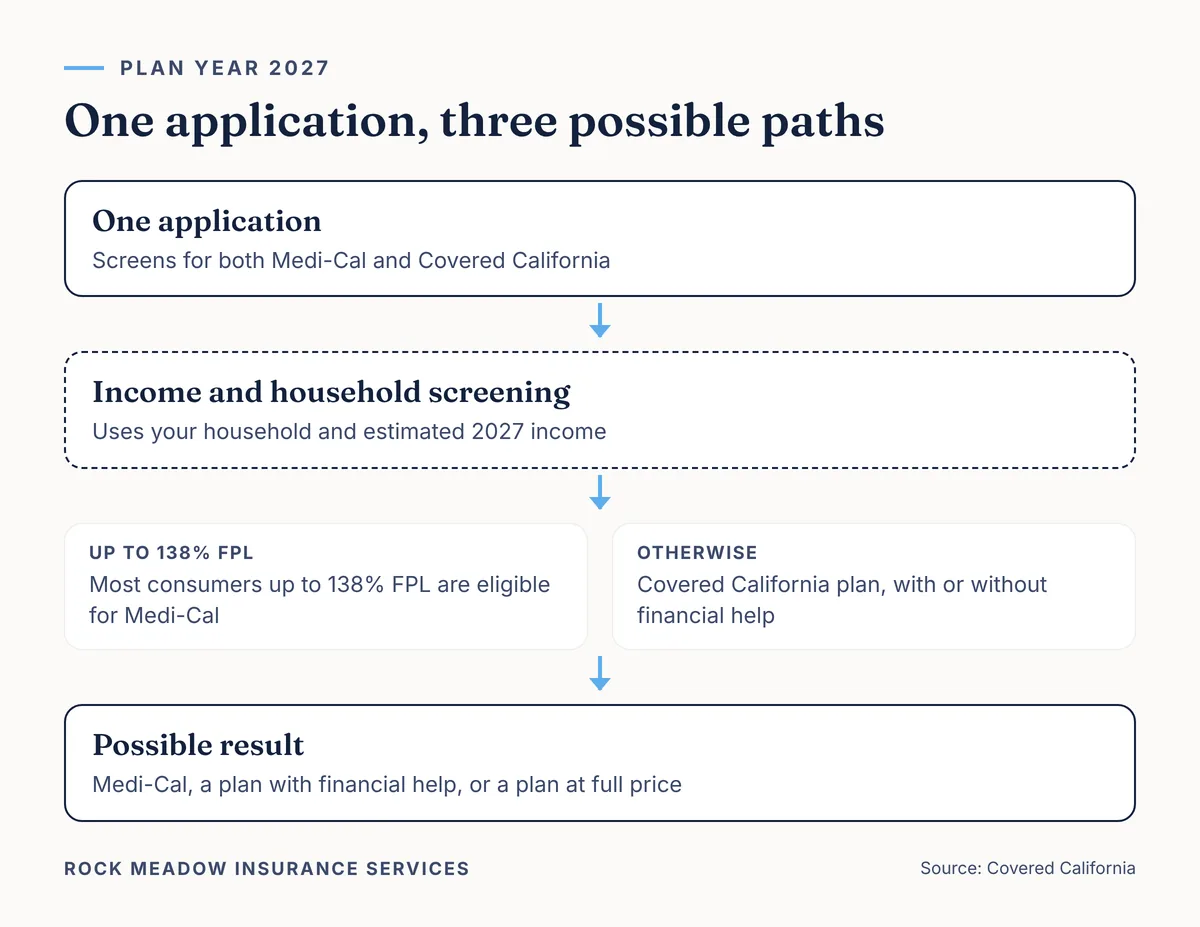
Medi-Cal is one of the programs the same application checks you for, and lower household income may route you there.
You enter your household and your estimated 2027 income, and the screening sorts you into one of three paths: Medi-Cal, a Covered California plan with financial help, or a Covered California plan at full price. Covered California’s 2027 eligibility chart notes that most consumers up to 138% FPL will be eligible for Medi-Cal.
Medi-Cal may be free or low-cost for you; that turns on income and household. Results can also be split within one household. Some members might be routed to Medi-Cal while others get a Covered California plan, and both can come out of the same application.
If a split result or a Medi-Cal notice is confusing, ask for the determination in writing and keep it with your records. And if the whole process feels like a lot, we wrote a short piece for that moment: if Covered California feels overwhelming.
An employer offer or Medicare usually rules out financial help
If you are offered employer coverage the IRS considers affordable, or you are eligible for Medicare, you usually cannot get the premium tax credit. The IRS says you may qualify for months you were not eligible for affordable, minimum-value employer coverage. The full wording, including what affordable and minimum value mean, is on the IRS premium tax credit eligibility page.
For an employer offer, the IRS looks at whether the coverage is affordable and provides minimum value. Ask HR in writing for the monthly cost of employee-only coverage before you apply, so you have the figure when the question comes up.
Medicare works on a different track. Once you are eligible for Medicare, the premium tax credit is usually off the table.
If you are still working at 65, see our guide on turning 65 while still working. Educators leaving early can read about coverage before 65 for retiring teachers, and our Medicare coverage in California page covers the switch itself.
Business owners have a separate path to look at: employer group health plans follow their own rules. If your situation sits near any of these lines, confirm it with a tax professional and keep the answer in writing.
Covered California rules are changing for 2027 and 2028
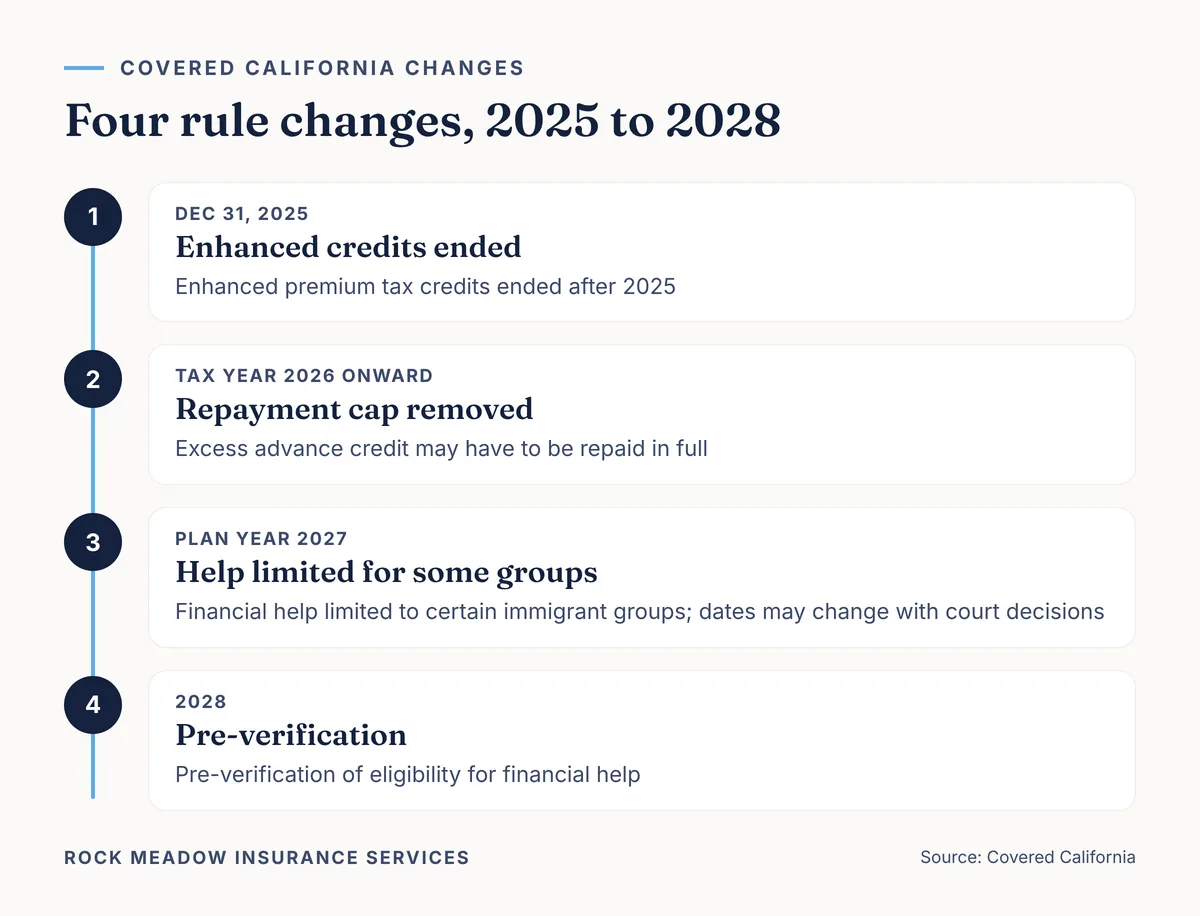
Several changes on Covered California’s important-changes page affect who gets financial help and how much, dated from 2025 through 2028. Of the four below, two have already taken effect, one starts with 2027 coverage, and one starts in 2028.
- Enhanced credits ended (Dec 31, 2025). The enhanced premium tax credits, the expanded financial help available through 2025, have ended.
- Repayment cap removed (tax year 2026 onward). If your income ends up higher than your estimate, you may have to pay back excess advance premium tax credit in full when you file. That makes a realistic 2027 income estimate, and mid-year updates, matter more.
- Financial help limited for some immigrant groups (plan year 2027). Covered California says only certain immigrant groups qualify for financial help in 2027. The page also says these dates may change with court decisions, so read its current wording rather than any summary, including ours.
- Proof before financial help (2028). Covered California says that from 2028 you’ll need to prove you qualify for financial help before it is applied. It doesn’t change 2027 enrollment, but it’s worth knowing before you renew.
What any of this means for your taxes is a question for a tax professional; we can only point to the rule. Before you apply, re-check Covered California important changes for 2026-2028, since it’s updated as rules change, and keep a copy of what it said.
You can apply during open enrollment or within a qualifying life event window
Covered California’s open enrollment runs Nov 1 to Jan 31, and enrolling by Dec 31 gives you coverage that starts Jan 1. Signing up in January still works, but coverage starts later. Covered California posts the current dates on its Covered California open enrollment dates page, so re-check them before you apply.
Outside that window, you usually need a qualifying life event to enroll. Covered California’s list includes job-coverage loss, marriage, a move to California and the birth of a child. Those events generally give you 60 days to pick a plan, and a 90-day window applies after losing Medi-Cal. Which window applies depends on the event, so read the details on qualifying life events and special enrollment and keep proof of the event’s date.
So "do I qualify for Covered California" has a timing part too. Meeting the eligibility rules doesn’t open enrollment by itself; the calendar or a life event does.
Before you submit, look over the last-minute Covered California mistakes people make. Once you’re in, our guide on what to do after you enroll in Covered California covers the next steps.
A licensed agent can walk through your eligibility questions before you apply
A licensed agent can explain how the eligibility questions work before you apply; Covered California makes the decision. Rock Meadow Insurance Services is a licensed agency, and Anthony Howe is a Certified Insurance Agent, Covered California, who helps anyone with Covered California questions. We are not Covered California and do not speak for it.
The work is practical: who belongs in your household, how to estimate your 2027 income, and what each step of the application asks, so there are fewer guesses going in. For background, see how a licensed agent can help with enrollment. Readers in either area can also see our pages on individual and family health plans in San Diego and individual and family health plans in Los Angeles.
The page to request help comparing individual and family plans is a request form for plan comparisons; it is separate from the application you file with Covered California.
Checklist: What to gather before you apply for 2027
Open enrollment for plan year 2027 opens Nov 1, 2026, so it helps to have these items ready before you start the application.
- Proof that you live in California, for each person applying.
- Social Security numbers or immigration information for each person who is applying.
- A household list that matches how you plan to file your 2027 taxes.
- An estimate of each household member’s 2027 income.
- Your most recent federal tax return.
- The monthly employee-only cost of any job-based coverage offered to anyone in the household, in writing from HR.
- The date your current coverage ends or your life event happened, plus Medicare status for anyone close to 65.
- A list of your doctors and prescriptions, so you can check networks later when you compare plans.
Common questions
What is the income limit for Covered California in 2027?
Buying a plan has no income cap; the limits apply to financial help. Covered California lists the premium tax credit at 100% to 400% of FPL and cost-sharing reductions at 250% FPL or less. Whether you get help, and how much, depends on income and household size.
Can I get Covered California if my employer offers insurance?
The IRS rule on employer offers is about the premium tax credit. If the offer is affordable under IRS rules and provides minimum value, you usually can’t get that credit. Whether an offer passes that test is an IRS question, so ask HR to put the employee-only offer details in writing.
Can I apply for Covered California outside open enrollment?
Yes, if you have a qualifying life event. Examples on Covered California’s list: losing a job-based plan, getting married, moving into the state, having a baby. Most events open a 60-day window; some allow 90 days. Otherwise, you’d wait for open enrollment, Nov 1 to Jan 31. Keep proof of the event date.
Can I get Covered California if I am not a U.S. citizen?
Possibly. Covered California is for California residents who are lawfully present. Its important-changes page says financial help for 2027 is limited to certain immigrant groups, and dates may change with court decisions. Families with mixed status can apply together. Covered California decides for each applicant.
Do I qualify for Covered California if I am self-employed?
Being self-employed doesn’t change eligibility; the same residency, status, household and income rules apply. Covered California lists self-employment income as income that counts. Because earnings can swing, an honest 2027 estimate, updated when income changes, matters, since excess credit may have to be repaid in full at tax time. A tax professional can confirm the numbers.
Where we help
Rock Meadow Insurance Services works with clients across California and nationwide. As a Certified Insurance Agent, Covered California, Anthony Howe can help you prepare your application, but Covered California makes the eligibility and financial-help decisions for plan year 2027, and we don’t speak for it.
You can reach us at (760) 654-6760. Bring the household, income or timing questions from this guide, and we’ll go through them with you before you apply. If it helps to talk things over first, you can contact a licensed agent at a time that works for you.
Sources
- Eligibility, Covered California: buying a plan is open to California residents who are lawfully present; who counts in the household; the same application that checks for Covered California and Medi-Cal; mixed-status households applying together, with only the people applying sharing Social Security numbers or immigration information.
- Open Enrollment, Covered California: open enrollment for plan year 2027 opens Nov 1, 2026 and runs to Jan 31, and enrolling by Dec 31 gives a Jan 1 start.
- Financial Help, Covered California: financial help based on income and household size; the premium tax credit (APTC) at 100% to 400% of FPL; cost-sharing reductions at 250% FPL or less; the income bands the application may screen for; the California Premium Subsidy for 2027; use of expected coverage-year income rather than last year’s; income that counts and does not count.
- Important Changes, Covered California: enhanced premium tax credits ended Dec 31, 2025; full repayment of excess APTC from tax year 2026; financial help limited to certain immigrant groups for plan year 2027; pre-verification starting in 2028; dates that may change with court decisions.
- Major Life Changes, Covered California: qualifying life events such as losing job coverage, marriage, a move to California and the birth of a child, with the 60-day window and the 90-day window after losing Medi-Cal.
- Eligibility for the Premium Tax Credit, IRS: the credit based on household income; married people filing separately generally not eligible, with exceptions for certain victims of domestic abuse or spousal abandonment; dependents unable to claim the credit; an affordable, minimum-value employer offer or Medicare eligibility usually ruling out the credit, and possible eligibility for months without such an offer.
- Coverage for Lawfully Present Immigrants, HealthCare.gov: the federal description of coverage for lawfully present immigrants.
- Program Eligibility by Federal Poverty Level for 2027, Covered California: the 2027 chart that shows the income ranges for each FPL level, and its note that most consumers up to 138% FPL will be eligible for Medi-Cal.