A certificate of insurance (COI) is a one-page summary of the coverage a business carries. It proves a policy exists, but it doesn’t add to or change what that policy covers.
Most business owners first hear the term in an email like this one: “Before you start on the 1st, please send over your COI with us listed as certificate holder.” Below, we’ll walk through what that request means, how to read the page once you have it, and how to check one someone hands you.
What is a certificate of insurance?
Think of it as a receipt for your insurance. Your policy might run dozens of pages; the certificate boils it down to one page someone else can read in a minute. It shows who your insurer is, your policy number, when the policy runs and your limits, which are the most each policy will pay.
Just as important is what it doesn’t do. A certificate can’t create coverage, and it can’t promise that a particular job is included. Say a client sees your certificate and asks, “Does your policy cover our project?” The certificate can’t answer that. The answer is in your policy documents, with their terms, limits and exclusions.
Who asks for one, and why
Whoever asks is about to rely on your work or let you into their space, and wants proof you’re insured before they do. A few situations you can expect:
- A landlord, before you get the keys. You’re signing a lease for a small shop, and the lease says you’ll provide a certificate before move-in.
- A client, before the work starts. A property manager hires your cleaning crew, or an event venue books your catering, and their contract asks for one.
- A homeowner hiring a contractor. State insurance regulators tell homeowners to ask for a certificate showing the insurance company, policy number and policy limits before work begins.
- A state agency. Licensed California contractors send workers’ compensation certificates to the Contractors State License Board (CSLB). And under California Labor Code section 3711, the Department of Insurance’s Fraud Division can ask any employer for proof of workers’ compensation coverage at any time, as its guide for employers explains.
Notice that in the first two, the requirement comes from a lease or contract, not from a law. That’s typical: clients, landlords and contracts often ask for a certificate as a condition of doing business. If you’re in the trades, our pages on contractor insurance, general liability insurance in California and workers’ compensation in California cover the policies behind these certificates.
How to read a certificate, box by box
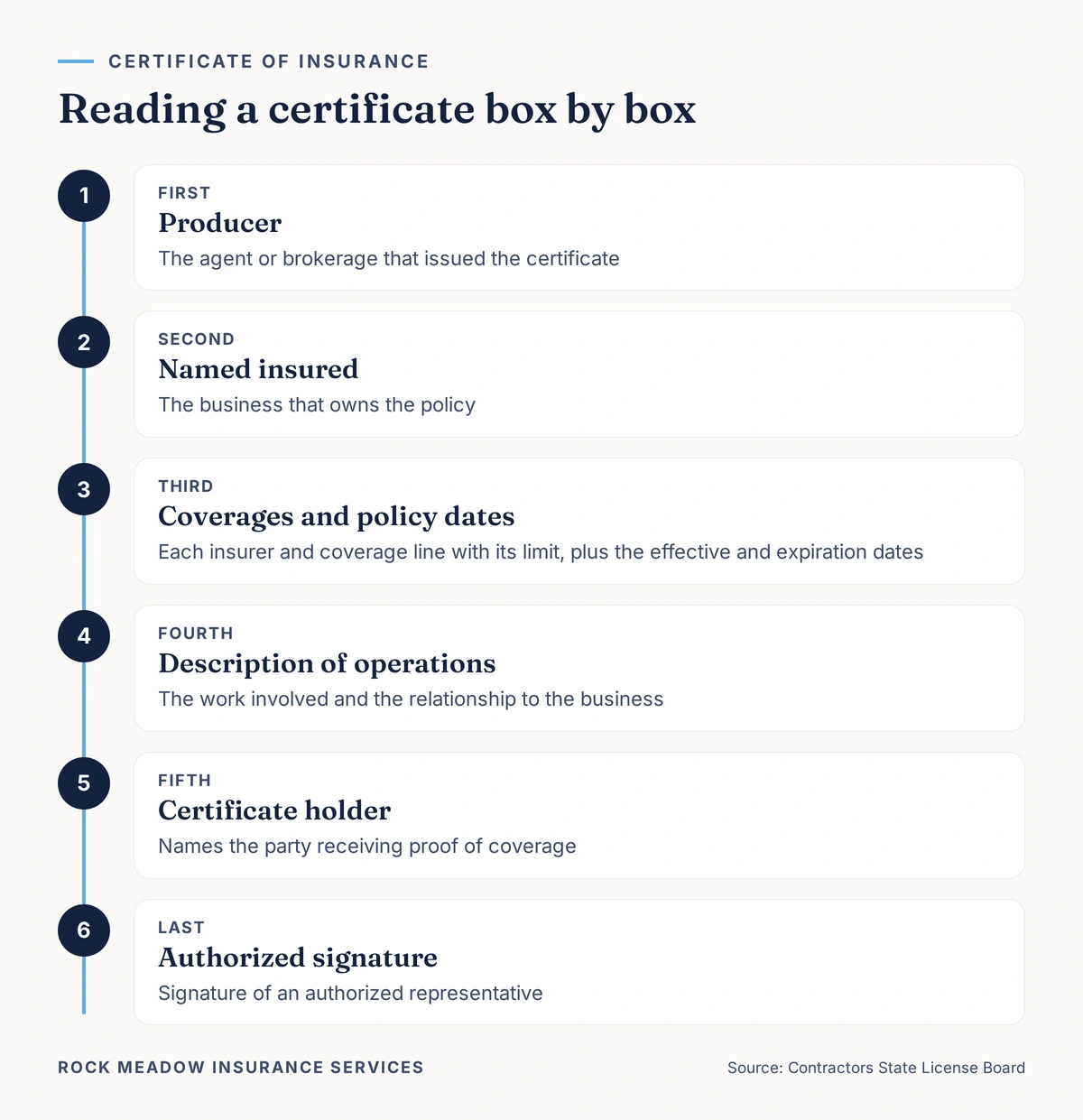
Picture a homeowner holding a certificate a remodeler just emailed over. Every box on it answers one of three questions: who is involved, what coverage is listed, and when it runs. Reading top to bottom:
- Producer: the agent or brokerage that issued the certificate. This is who to contact if something on it is wrong.
- Named insured: the business that owns the policy. It should be the remodeler’s business, spelled the way it appears on their contract.
- Insurers and coverages: the companies behind each policy, the type of coverage and the limit for each.
- Policy dates: when each policy starts and ends. A policy that ends before the project does is worth a question.
- Description of operations: the work or relationship the certificate is for.
- Certificate holder: who is receiving the proof. Here, the homeowner.
- Authorized signature: the producer’s sign-off.
Each requester decides what it needs in those boxes, and some are very specific. CSLB’s certificate of insurance requirements are a good example: the producer’s name and address, a business name that matches the license exactly, CSLB as the certificate holder, both policy dates, a clear description of the relationship and services, and a wet signature (original ink, not a stamp or e-signature). A landlord or client may want something else entirely, which is why it pays to ask before you request the certificate.
Certificate holder vs. named insured
These two boxes get mixed up more than any others. The named insured owns the policy. The certificate holder is the party asking to see proof of it.
Back to the catering example: your business is the named insured, and the venue is the certificate holder. Being listed as holder lets the venue see your coverage, but it doesn’t give the venue any coverage under your policy.
| Role | Who it is | Example: when CSLB is asking |
|---|---|---|
| Named insured | The business that holds the policy | The name must match the CSLB license exactly |
| Certificate holder | The party receiving proof of coverage | CSLB itself must be listed |
One snag to watch for is a name mismatch. Your lease lists your business with “LLC” at the end but your policy leaves it off, or the venue’s legal name is different from the name on its sign. If either box doesn’t match what the requester has on file, ask the agent who issued the certificate for a corrected one.
How to check a certificate you received
Now flip it around. You’re the homeowner, or the property manager, and someone has sent you their certificate. The reliable check is a phone call to the insurance company named on it. Look up the insurer’s number yourself, on its own website for example, rather than relying only on the number printed on the page. Then ask three questions:
- Is this policy number active?
- Do the dates match the current term?
- Is the business on the certificate the one that holds the policy?
If anything doesn’t match, ask the business for a corrected certificate. The California Department of Insurance also points to two warning signs:
- A certificate that looks state-issued. The Department regulates insurers but doesn’t issue certificates. One of its fraud alerts describes a fake certificate carrying the Great Seal of the State of California.
- A contractor who won’t provide one from their general liability or workers’ compensation insurer, per its tips on hiring contractors.
Neither one proves anything by itself. Either way, the next step is the same call to the insurer.
Policies that usually appear
Most certificates list one or more of these:
- General liability: for claims that your business caused injury or property damage, plus the cost of defending a lawsuit.
- Business owner’s policy: a package that bundles common coverages, usually general liability and property, into one policy.
- Workers’ compensation: for employees hurt on the job. It also comes with state rules for employers, which the California Department of Industrial Relations (DIR) can confirm for your business.
- Commercial property: sometimes listed; for damage to the business’s own property.
Each line on the certificate points to a policy, and what that policy includes is set by its own documents. The U.S. Small Business Administration (SBA) guide to business insurance describes each type in more detail.
How to get a certificate of insurance
Back to that email asking for your COI. The certificate comes from the agent or insurance company that handles your policy, so that’s who you contact. Before you do, reply to the requester and ask exactly what they need, ideally in writing. Then pass three things along to your agent:
- Who should be listed as the certificate holder, with their full legal name and address.
- Your business name exactly as the requester has it.
- Any wording they want in the description of operations, and which policies and dates they want shown.
One thing a certificate can’t fix: it only reports coverage you already have, such as a business owner’s policy in California. If a contract asks for a coverage you don’t carry, that’s a conversation about the policy, not the certificate. If you don’t have an agent yet, the SBA suggests working with a reputable, licensed one.
Checklist
- Ask the requester what they need on the certificate, in writing.
- Request it from your agent or carrier, with the holder’s name and any wording.
- Check the insurer, policy number and limits.
- Match the business name to the requester’s records.
- Confirm the holder box names the party that asked.
- Check that the policy dates cover the work or the lease.
- Received one? Call the insurer to verify it, and look twice at anything that looks state-issued.
Common questions
Can I put more than one certificate holder on my certificate?
The holder box names the party receiving the certificate. If a client and a landlord both want proof, ask your agent how to handle it, and ask each requester in writing how they want to be listed.
How long is my certificate good for?
As long as the policy term printed on it. A certificate has no expiration date of its own, so ask your agent for a fresh one after each renewal and send it to anyone who still needs it.
Can I make my own certificate?
No. Certificates come from the agent or insurance company that handles your policy. The Department of Insurance doesn’t issue them either, so a homemade or state-looking certificate is a reason to call the insurer.
Do I need a certificate if no one has asked for one?
Usually a certificate only comes into play when someone asks: a client, a landlord, a contract or a state agency. If you’re not sure whether a licensing board expects one from you, that board can tell you.
What if the dates on a certificate I received have passed?
Then it no longer shows a current policy. It may simply mean the policy renewed and no one sent a new copy, so ask the business for an updated certificate and call the insurer named on it to check.
Where we help
We work with clients across California and nationwide. If a client, landlord or state agency has asked you for a certificate and you’d like to talk it through, call us at (760) 654-6760 or contact Rock Meadow. We also have local pages on a business owner’s policy in Los Angeles and a business owner’s policy in San Diego.
Sources
- Don’t Get Scammed After a Disaster, California Department of Insurance. Supports what a certificate shows (the insurance company, policy number and policy limits) and that you can contact the insurer directly to verify it. Also lists a contractor unwilling to provide a certificate from a general liability or workers’ compensation carrier as a warning sign.
- Loan Insurance Protection Scam, California Department of Insurance. Supports that the Department regulates the insurance industry and does not issue certificates. Also describes a fake certificate made to look state-issued, carrying the Great Seal of the State of California.
- CSLB Certificate of Insurance, CSLB. Supports the example of what one requester checks: producer name and address, a business name that matches the license exactly, CSLB as certificate holder, a clear description of operations, and a wet authorized signature.
- Workers’ Compensation Requirements, CSLB. Supports that CSLB must be listed as certificate holder and that the policy’s effective and expiration dates must appear on the certificate.
- Workers’ Compensation: What Employers Need to Know, California Department of Insurance. Supports the Fraud Division’s authority under Labor Code section 3711 to request proof of workers’ compensation coverage at any time.
- Get business insurance, U.S. Small Business Administration. Supports the short descriptions of general liability, a business owner’s policy and commercial property, and the guidance to find a reputable licensed agent.
Coverage, limits, exclusions and eligibility vary by policy and insurance company, and the policy documents decide what is covered. This article is general information, not legal or tax advice; confirm licensing, bond and workers' compensation requirements with the agency that applies to your business.