Reviewed by Anthony Howe, Licensed Insurance Agent, NPN #20649362, CA License #4281027 on 2026-11-16
What this article covers: Why the price ranges you find online don’t fit your business, and the eight facts insurers commonly look at, from your type of work to your claims record and how you prevent losses.
How general liability, property and business interruption coverage each get priced, and where limits and deductibles fit in. Why workers’ comp is priced on payroll once you hire. What a business owner’s policy (BOP) bundles, what it leaves out and who may not qualify, plus the list of facts to gather before you ask for a quote.
How much does business insurance cost?
A new lease just landed. Or a client sent a contract, or your first hire starts soon. Now insurance is real, and you want a number.
So you search "how much is insurance for a business." You find price ranges built on other businesses, not yours.
There is no single price. Each insurer rates your business on its own facts, and a quote built on your details is the number that counts.
Your premium is what you pay for the policy. Rating is how an insurer turns your details into that premium. For what the coverage itself does, see our small business insurance page.
If you formed an LLC, that doesn’t stand in for insurance. The SBA says an LLC’s protection from lawsuits has limits, and business insurance can fill the gaps. See what an LLC protects and what it doesn’t.
Since the price comes from your details, start with which details insurers look at.
What do insurers weigh on a quote?
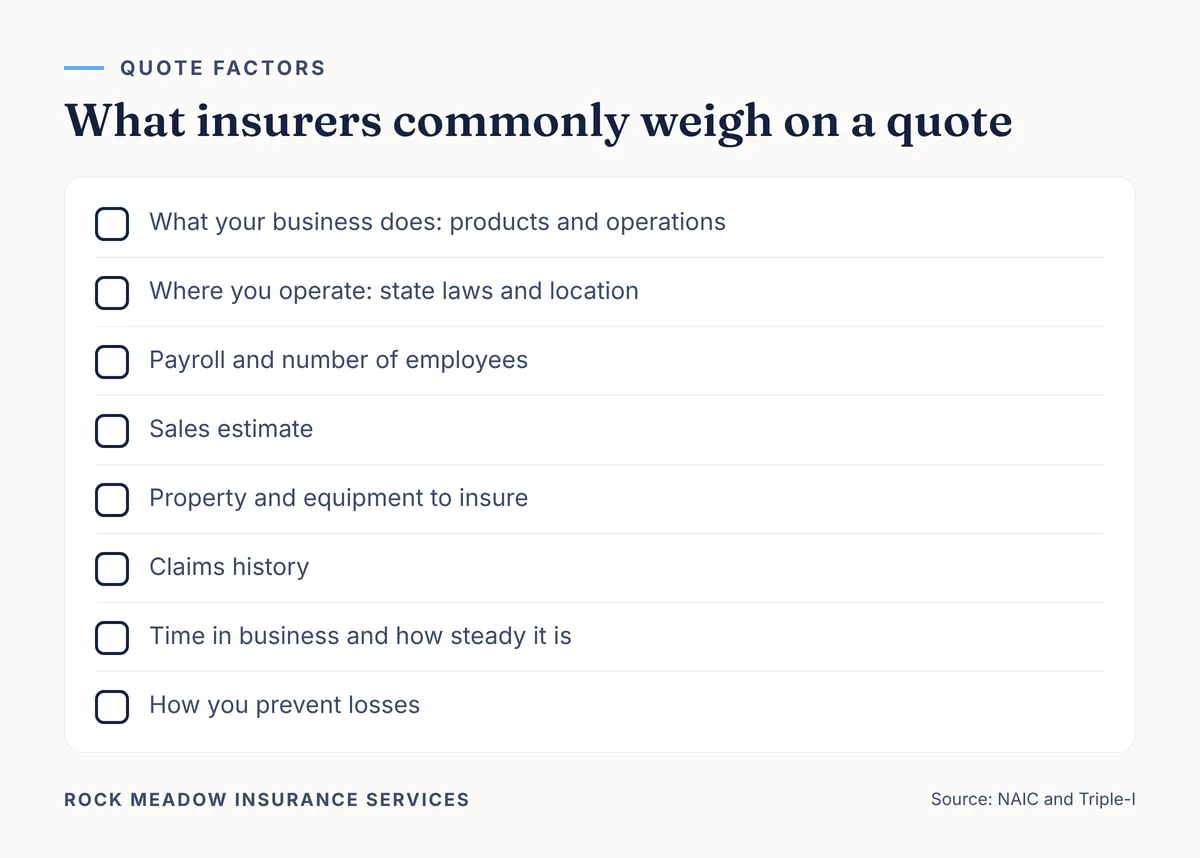
These are the details behind any small business insurance cost. NAIC’s guide to small business insurance lists the factors insurers use to judge liability risk. Insurers commonly weigh these:
- What your business does: your products and operations, and how many claims your industry sees.
- Where you operate: state laws are on NAIC’s list, and business insurance rates vary by location.
- Payroll and employees: liability premiums are linked to the payroll estimate you give before the policy starts.
- Sales: the same premiums are linked to your sales estimate.
- Property and equipment: the building, inventory, furniture and machines you want a property policy to insure.
- Claims history: the claims your business has had in the past.
- Time in business: how long the business has run and how steady it is on money.
- How you prevent losses: your approach to preventing risks, such as safety steps you write down and follow.
Claims history carries real weight. To an insurer, your past claims point to your future claims. A higher risk of future claims means a higher premium. Triple-I’s guide to liability insurance for small businesses says both.
It works the other way too. Firms with a good claims record tend to have more insurers competing for their business. That makes coverage easier to find.
No single factor sets the price. Each insurer weighs them in its own way. Your facts set the risk, and the coverages you choose set what that risk is priced against.
How do the coverages you pick shape price?
The same business can get different quotes. It depends on which coverages and options it asks for. Three common coverages compare like this.
| Coverage | What it is for | What insurers commonly look at to price it |
|---|---|---|
| General liability | Claims that your business hurt someone or damaged their property | The type of product or service you provide and how risky it seems |
| Commercial property | Damage to or loss of your building, equipment and inventory | How broad the coverage form is, plus any add-ons |
| Business interruption | Lost income and ongoing bills after a covered shutdown | The type of business you run |
Small business liability insurance cost follows your type of work and how risky it seems. Coverage under general liability insurance leaves out mistakes in professional advice or services. Those fall under professional liability, a separate policy.
With commercial property insurance, the form matters. Some policies list the causes of loss they cover. A "special form" policy covers all causes except the ones it excludes by name, so its premium may be higher. Add-ons such as outdoor signs, money and securities, or mechanical breakdown cost extra premium.
Business interruption is meant for more than lost income. It also deals with ongoing bills like payroll and utilities. NAIC gives an example: a travel agency needs less of it after a fire than an art gallery, because the gallery takes longer to recover. Our article on what business interruption coverage pays goes further.
Limits and deductibles
A limit is the most the policy will pay for a covered loss. The limits you ask for are part of what a quote is built on. Clients, landlords and lenders often set limits in their contracts. They tend to ask for proof as well, which is what a certificate of insurance shows.
A deductible is the part of a covered loss you pay before the insurer pays. Some insurers may offer a choice of deductible, but you’ll need to ask your agent whether yours does. If one is offered, Triple-I’s advice is to pick an amount you could afford to pay after a loss. Ask your agent what the insurer offers.
One coverage is priced on payroll above all, and it shows up with your first hire.
What changes when you have employees?
That first hire brings workers’ compensation insurance into the quote. It is for an employee’s medical bills, recovery costs and lost wages after a work-related injury or illness.
Businesses with employees are generally required to carry workers’ comp. The rules come from each state, and SBA’s page on business insurance points you to yours.
Price works a little differently here. For a new business, insurers commonly weigh four things:
- Total payroll
- Number of employees
- Pay per employee
- Type of work
For an established business, its workplace safety history counts too. For the details, see how payroll and class codes set a workers’ comp premium.
Workers’ comp is also one of the coverages a business owner’s policy leaves out. That matters when you price a package.
Is a business owner’s policy less costly?
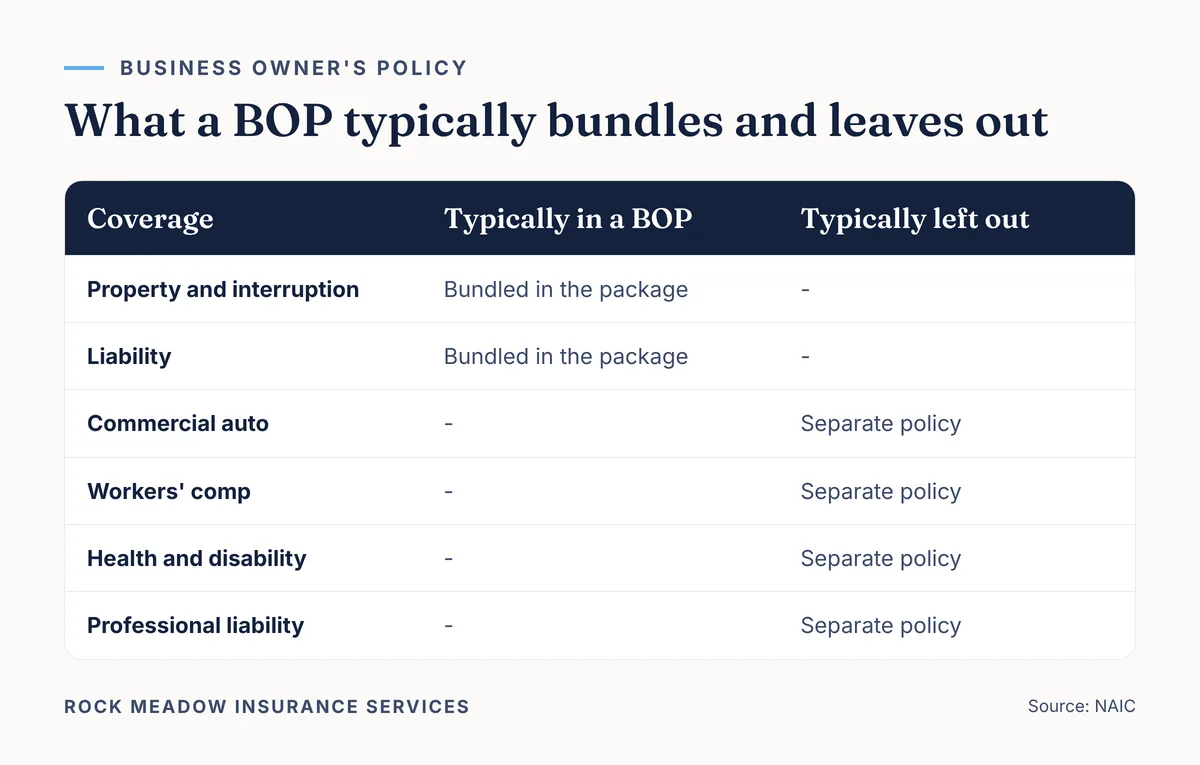
Some coverages do travel together. A business owner’s policy (BOP) is one package that combines property, business interruption and liability insurance. Many insurers also shape BOPs for certain types of businesses.
For many small businesses, a BOP can be a less costly option than buying the same coverages as separate policies. That’s one way a package can shape your business insurance cost. A home-based business or a company with a few employees may start with a BOP and add coverage as it grows.
Not every business qualifies. NAIC’s examples are a factory or a jewelry store, which usually need more custom coverage because of their risks. Underwriting, the insurer’s review of your business before it offers a policy, decides who qualifies.
A BOP typically leaves these out:
- Commercial auto. Vehicles need a separate policy. We can quote commercial auto alongside your BOP.
- Workers’ comp. Priced on payroll and type of work, as above.
- Health and disability insurance. Plans for you and your team.
- Professional liability. Claims of mistakes in professional services.
Each of these is priced on its own. If a BOP fits your business, you can request a business owner’s policy quote with your details. A quote is only as close as the details you send.
What to have ready for a quote
Whatever you buy, the quote starts from the details you hand over. Accurate ones matter most: what your business does, and honest payroll and sales estimates, since liability premiums are linked to the figures you give before the policy starts.
If a contract, lease or lender set insurance terms, include that clause with your quote request. It tells us which coverages to ask insurers about. Questions about what the clause means go to your attorney.
Coverage, limits and exclusions (what a policy doesn’t cover) vary by policy and insurer, and the policy documents decide what is covered. Insurers commonly ask for details like these:
- What your business does and how long it has run
- Where you operate, with addresses and ZIP codes
- Payroll and number of employees, by type of work
- Your yearly sales estimate
- Property and equipment you want insured, with values and receipts
- Past claims (your loss history)
- Insurance terms from contracts, leases or lenders
- Vehicles used for business, which go on a separate policy
If your business doesn’t fit a BOP, you can request a general liability quote instead.
Common questions
How much does business insurance cost for my LLC?
The same factors apply as for any other business. Forming an LLC doesn’t set a price of its own. NAIC’s list of what insurers weigh for liability risk covers your products and operations, claims in your industry, state laws, your time in business and how you prevent losses. Business structure isn’t on that list.
Why did I get different quotes for similar businesses?
Each insurer has its own way of rating a business, so quotes can differ. Small differences in what you sell or do can matter. Liability premiums depend on the type of product or service and how risky it seems. Your claims record counts too.
How much coverage does my small business need?
There’s no one amount; it follows the risk your work carries. In Triple-I’s example, a business that makes power tools faces more lawsuit risk than one that sells towels, so it needs more liability coverage. Your trade association can show the lawsuits common in your field. Bring any limits a lease or contract lists, and ask your agent.
Can I lower my business insurance cost?
No step promises a lower price. Accurate details give insurers a true picture. Fewer claims matter, since insurers treat past claims as a sign of future ones.
NAIC’s safety tips include good lighting, stairways and floors in good repair, and smoke and fire alarms. Some insurers may offer credits or a deductible choice, but you’ll need to ask your agent.
Can my premium change after the policy starts?
Yes, it can. Liability premiums start from the sales and payroll figures you estimate. If the real numbers come in higher, you may owe more premium. If they come in lower, you may get a refund. From year to year, changes in staff, products, inventory or your building can also change your premium.
Where we help
Clients across California and nationwide work with Rock Meadow Insurance Services. To see numbers built on your own business, you can start a business owner’s policy quote with your details.
If you’d rather talk it through, call us at (760) 654-6760. You can also contact our team to set up a time to talk about which coverages to ask insurers about. There’s no pressure to buy. If your policy is with Rock Meadow, our team turns certificate requests around fast when a client or landlord asks for proof.
Sources
- Insuring Your Business: Liability Insurance, Insurance Information Institute (Triple-I). Supports that insurers treat past claims as a predictor of future claims and that a greater risk of future claims means a higher premium; that professional liability is a separate policy from general liability; its advice to pick a deductible, if one is offered, that you could pay after a loss; and that good liability risk management helps keep premiums under control.
- Insuring Your Business: Property Insurance, Insurance Information Institute (Triple-I). Supports that businesses with a good claims record have more insurers competing for them, so coverage is easier to find; that "special form" property coverage is broader, so its premium may be higher; that add-ons such as outdoor signs, money and securities, and mechanical breakdown cost extra premium; that vehicles need a separate policy; and that businesses that work on cutting risk have fewer claims on average.
- Small Business Insurance consumer guide, National Association of Insurance Commissioners (NAIC). Supports the factors insurers weigh on a quote (operations, location, payroll, sales, claims history, time in business, loss prevention); that liability premiums are linked to the sales and payroll estimates given before the policy starts; how general liability and business interruption are priced; the definition of a limit; the workers’ comp premium factors; and what a business owner’s policy bundles, when it can cost less than separate policies, who may not qualify and what it leaves out.
- Get Business Insurance, U.S. Small Business Administration (SBA). Supports that an LLC’s protection from lawsuits has limits that business insurance can help fill; that business insurance rates are among the costs that differ by location; and the article’s statement on workers’ comp for businesses with employees, along with where to look up your state’s insurance laws.
Coverage, limits, exclusions and eligibility vary by policy and insurance company, and the policy documents decide what is covered. This article is general information, not legal or tax advice; confirm licensing, bond and workers' compensation requirements with the agency that applies to your business.