Reviewed by Anthony Howe, Licensed Insurance Agent, NPN #20649362, CA License #4281027 on 2026-11-13
What this article covers: The four parts of a food truck to insure, and why a personal auto policy can fall short for a work truck, trailers included. General liability for customers and food. Coverage for the kitchen build-out, spoilage and downtime, and where a business owner’s policy fits. Workers’ comp for your crew. Event and commissary requests, what sets the price and what to have ready for a quote.
What does food truck insurance cover?
An event organizer wants a certificate of insurance before you can park. That’s a short document that proves your coverage exists. Your commissary, the shared kitchen where you prep and store food, may want one too.
Or the lender on your truck asks for proof of coverage. Or you just noticed your car insurance may not fit a vehicle you use for work.
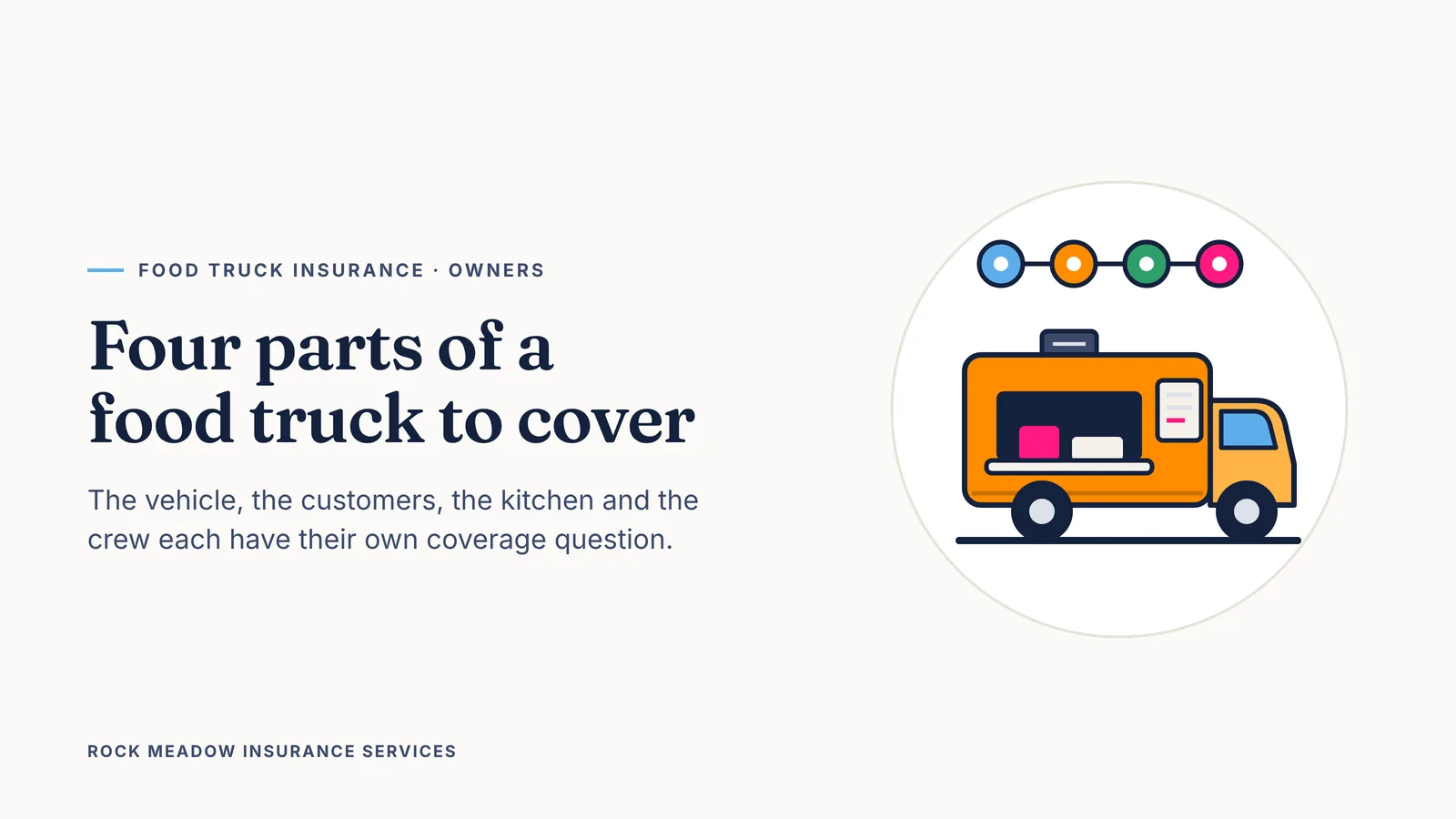
Here’s the short answer. Food truck insurance is a set of policies built around one business, not a single policy. A truck usually needs coverage in four places.
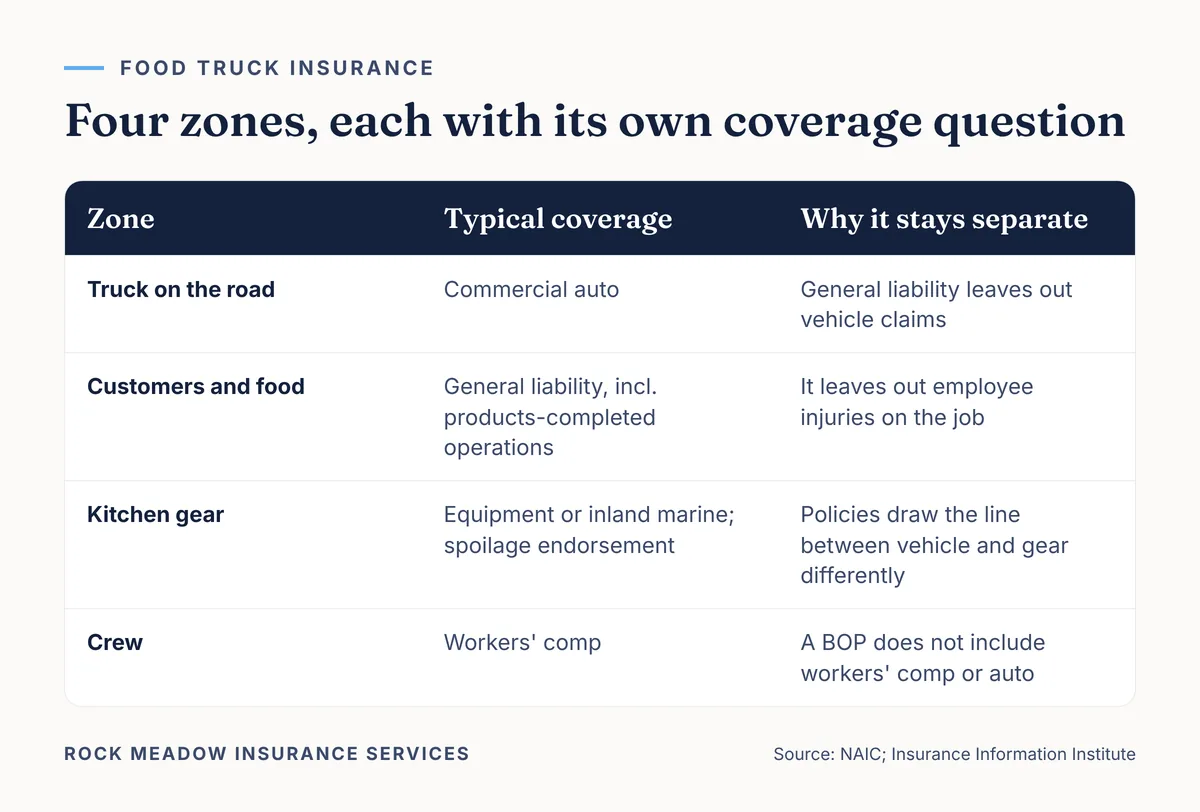
Those four are the vehicle on the road, the customers and the food, the kitchen gear inside, and anyone who works for you. Commercial auto, general liability, equipment or property coverage, and workers’ comp each answer one of them. A business owner’s policy bundles several coverages. It does not include auto insurance or workers’ comp.
A truck has the same food risks as a sit-down place, and our restaurant insurance page covers those. The focus here is what changes when the kitchen has wheels.
An LLC doesn’t replace insurance either. The U.S. Small Business Administration (SBA) says an LLC can shield your personal property from lawsuits only up to a point. We explain what an LLC protects and what it doesn’t, and SBA’s Get business insurance (SBA) page lists common business coverages.
The truck itself is often where the first gap shows up, so start there.
Does your personal auto policy cover the truck?
If the truck sits on a personal auto policy today, that policy covers some business use. When business use is too much risk, the insurer may charge more, refuse to insure or cancel the policy. Personal auto policies often exclude or limit business use, and the policy documents decide.
A commercial auto policy is car insurance written for vehicles a business owns or uses for work. Your agent asks how you use the truck, who drives it and who owns it. For a food truck, the answers usually point to business use. The truck works most days, carries a kitchen, and staff may drive it.
Who holds the title matters. Insurers often write a truck owned by the business on a commercial policy. The business is then named as the principal insured, meaning the main policyholder.
The Insurance Information Institute (Triple-I) covers the other differences in its Business Vehicle Insurance (Triple-I) guide and Do I need a commercial auto insurance policy? (Triple-I).
Food trailer insurance starts with the same questions. The standard business auto form counts trailers as autos, along with cars, trucks and vans. The tow vehicle’s policy and how you use it matter too.
Physical damage coverage is for the vehicle itself. Collision is for losses when the truck hits something or rolls over. Comprehensive is for most other causes, such as fire, theft or flood, with a few exclusions like wear and tear. The kitchen built inside is a separate question.
One more gap: a personal umbrella policy, which adds liability on top of your home and car policies, generally excludes business liability.
| Personal auto policy | Commercial auto policy | |
|---|---|---|
| Built for | Household cars and everyday driving | Vehicles a business owns or uses for work |
| Business use | Some is allowed; too much can mean a higher price, a refusal or a canceled policy | Written for business use; each vehicle can be listed with its own coverages |
| Employees driving | Built around you and your household | Set up around who drives for the business |
| Title in the business name | Insurers often move it to a commercial policy | Business named as principal insured |
| Installed kitchen gear | Ask how built-in gear is treated | Ask how built-in gear is treated and whether coverage can be raised for it |
| Trailers | Depends on the policy and the tow vehicle | Counted as autos on the business auto form |
| Trade-offs | One familiar policy, with limits on business use | Fits business use, but it’s a separate policy with more details to set up |
Auto covers the truck on the road. Once the window opens and food goes out, a different policy answers.
Who covers customers and the food you serve?
That policy is general liability. It’s coverage for injury or property damage you’re held responsible for toward people outside your business. Think of someone who falls at your business, or a customer hurt by a product you sell. Our page on general liability coverage for customers has the basics.
One part of general liability typically covers harm from the food you sold. SBA describes product liability as protection against loss when a product causes injury. For a truck, the product is the food. A claim that a meal made someone sick is handled under this part of the policy, subject to its terms, limits and exclusions.
Picture a customer who slips in line at the service window. Or a guest who gets sick after eating. Or an awning or generator that damages a venue’s property. These are the kinds of claims food truck general liability insurance is built for.
What it leaves out matters just as much. Standard general liability doesn’t protect against claims from operating a vehicle, or against employee injuries on the job. That’s why the auto policy and workers’ comp stay separate pieces. The National Association of Insurance Commissioners (NAIC) lists the other exclusions on its Small Business Insurance (NAIC) page.
If your truck serves alcohol, liquor liability is a separate coverage to ask about.
Liability covers the people around the truck. The gear inside it is a separate question.
How to protect the kitchen and the food
Auto physical damage may not reach the kitchen you built inside. That means the fryers, griddles, refrigeration and generator.
Equipment and the build-out
NAIC suggests raising the coverage on a business vehicle to include permanently attached items, such as a generator. For insurance purposes, business property can include equipment and machinery, owned or leased. Inland marine is coverage for business property that moves from place to place. It or an equipment form is often how kitchen gear gets covered, which is what people mean by food truck equipment insurance.
Spoilage and downtime
Food spoilage coverage is for stock lost after a power outage or a refrigeration failure. It’s typically an endorsement, which is a written add-on to a policy.
Business interruption is lost income during a covered shutdown, such as the truck sitting in the shop after a covered loss. It can be added to a property policy or bought as part of a package. Our page on property coverage for equipment shows how the property and income pieces work together.
Where a BOP fits
A business owner’s policy (BOP) packages property, business interruption and liability coverage. Not all businesses qualify for one. A mobile business may qualify with some insurers, and that’s up to the insurer. Even then, the BOP sits beside commercial auto and workers’ comp, not in place of them.
Triple-I’s What does a business owners policy cover? (Triple-I) lays out the full package.
| Coverage | What it’s for | How it’s added | What to ask |
|---|---|---|---|
| Equipment or inland marine | Kitchen gear and the build-out, including gear that travels with the truck | Separate coverage form or endorsement | Is installed gear part of the vehicle, or does it need its own coverage? |
| Food spoilage | Stock lost after a power or refrigeration failure | Endorsement | Which causes count, such as an outage or a breakdown? |
| Business interruption | Lost income during a covered shutdown | Added to a property policy or part of a package | Does it apply while the truck is in the shop after a covered loss? |
| BOP | Property, interruption and liability in one package | Package policy | Does the insurer offer a BOP to a mobile business? |
With the gear and the food sorted, the last zone is the people working inside.
Does your crew need workers’ comp?
Workers’ comp is insurance for employees who get hurt or sick because of their work. Most states require employers to carry it, and each state’s workers’ comp agency sets the rules. SBA notes that the laws requiring business insurance vary by state. Confirm the rules for your truck with your state’s workers’ comp agency.
Food truck workers comp typically pays an injured employee’s medical costs, rehabilitation and lost wages, subject to the policy’s terms, limits and exclusions. That’s the gap general liability leaves open for your own staff.
Small crews raise a common question: does part-time help count? State law sets who counts as an employee. We don’t make that call for a specific worker, and your state agency can tell you how its rule applies.
Our page on workers’ comp for your crew covers how the coverage works. If you already have staff, you can request a workers’ comp quote alongside the rest of your coverage.
With all four pieces in place, the next ask usually comes from an event or a commissary.
Before your next event or quote
What events and commissaries ask for
Event organizers, festivals, commissaries and property owners often ask for a certificate of insurance. Many also ask to be added as an additional insured, which extends part of your coverage to them. The limits they want are the ones named in the event or commissary agreement, not ones set by a law.
Our article on how to get a certificate of insurance walks through the request. The difference between the two asks is in additional insured vs certificate holder.
Permits and health department rules are a separate track. SBA says restaurants are commonly regulated locally. Confirm what your truck needs with your city or county.
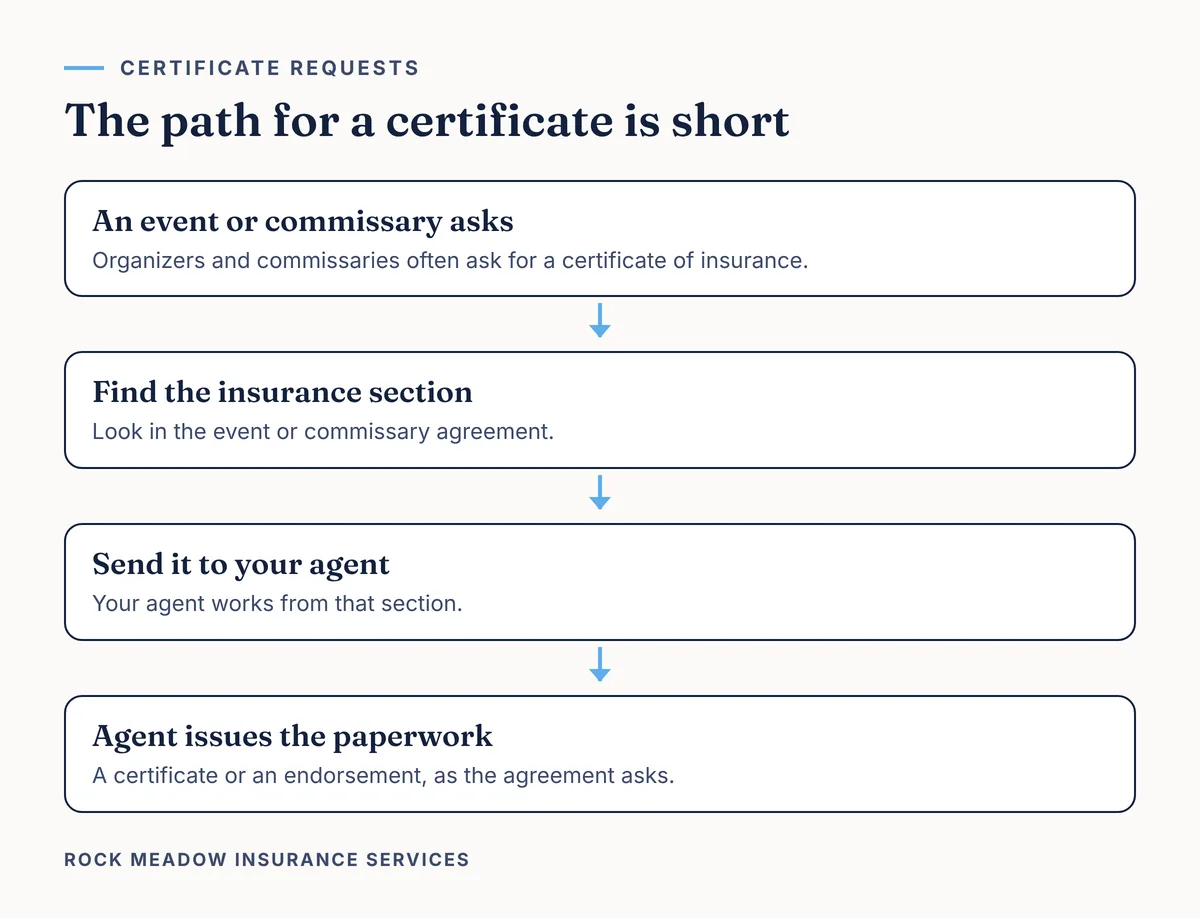
The path for a certificate is short. Find the insurance section of the agreement and send it to your agent. Your agent issues the certificate or the endorsement. If your policy is with Rock Meadow, our team turns certificate requests around quickly, so talk with our team when one comes in.
What sets the price
There’s no set price, only the things that move it. General liability premiums are tied to your sales and payroll estimates. Your event calendar feeds the sales estimate.
What you cook matters too, since the type of business and its operations shape the risk. A menu built on fryers and propane reads differently from one built on cold drinks.
On the vehicle side, the type of vehicle and your claims history affect cost. Driving records count as well. Hiring drivers with good records helps keep business auto costs down.
What to have ready for a quote
- The truck’s VIN, year, make and model, plus the tow vehicle if you pull a trailer
- A list of your kitchen equipment and what each piece is worth
- Your menu and cooking method, such as fryers or propane
- Your event calendar for the coming year
- A payroll estimate, including part-time help
- The insurance section from an event or commissary agreement
You can include that insurance section with your quote request, so we know which coverages to ask insurers about. Coverage, limits and exclusions vary by policy, and the policy documents decide. Get the final terms in writing before your event date.
When you’re ready, request a general liability quote. Our team can quote the whole package, truck included.
Common questions
Do I need commercial auto insurance for my food truck?
It depends on the truck, but food trucks are often written on commercial auto because they work most days. The insurer looks at ownership, drivers and daily use. Having the title, a list of drivers and your weekly schedule on hand speeds up that talk. The insurer then decides which policy it will write.
Does my personal car insurance cover my food truck or trailer?
Only for limited business use, and a truck that works full time can go past that. A personal policy is designed around household driving. If the insurer sees more work use than it accepts, the price, the policy or both can change. For a trailer, ask about the trailer and the vehicle pulling it, and get the answer in writing.
What insurance do events ask my food truck for?
Usually proof of general liability on a certificate, often with a request to be named additional insured. The event agreement spells out which coverages and limits it wants. Some agreements also list auto or workers’ comp. Pull the insurance section from the agreement early, so there’s time to add anything missing before the event.
Does insurance cover my generator and fryer?
They can be covered, through one of two routes. One is raising the truck’s own coverage to take in items bolted to it, a step NAIC points to for a generator. The other is a separate equipment or inland marine form. A list of each appliance and its value helps your agent compare the two.
Do I need workers’ comp for one part-time employee?
It depends on your state. Most states require employers to carry workers’ comp, and each state decides whether part-time help counts. SBA points out that these insurance laws differ from state to state. Check with your state’s workers’ comp agency, and have your crew’s hours and roles ready when you ask.
Where we help
Rock Meadow Insurance Services works with clients across California and nationwide. To get started on coverage for your truck, start a general liability quote. Our team can quote the vehicle, the kitchen gear and workers’ comp on the same account.
Prefer to talk first? Call (760) 654-6760. If you’d like to go over how the pieces fit for your truck and your event calendar, you’re welcome to set up a time with our team. Bring your questions, and we’ll work through them at your pace.
Sources
- Business Vehicle Insurance, Insurance Information Institute (Triple-I). Supports: a personal auto policy covers only some business use, and the insurer may charge more, refuse or cancel when that use is too much risk; a business-owned truck belongs on a commercial policy; the business auto form counts trailers as autos; what comprehensive covers; and hiring drivers with good records helps keep business auto costs down.
- Do I need a commercial auto insurance policy?, Insurance Information Institute (Triple-I). Supports: business and personal auto policies share the same main coverages but differ in technical ways; a business that owns the vehicle is named as the principal insured; and personal umbrella policies generally exclude business liability.
- Small Business Insurance, National Association of Insurance Commissioners (NAIC). Supports: what general liability covers and that it excludes vehicle and employee injury claims; covering permanently attached items such as a generator; business property and business interruption; that not all businesses qualify for a BOP; what workers’ comp pays for and who counts as an employee; and what affects premiums.
- Get business insurance, U.S. Small Business Administration. Supports: an LLC’s protection has limits; general and product liability as common coverages; businesses with employees are required to have workers’ comp, with laws varying by state; and restaurants are commonly regulated at the local level.
- What does a business owners policy cover?, Insurance Information Institute (Triple-I). Supports: a BOP packages property, business interruption and liability coverage, and does not include auto insurance or workers’ comp.
Coverage, limits, exclusions and eligibility vary by policy and insurance company, and the policy documents decide what is covered. This article is general information, not legal or tax advice; confirm licensing, bond and workers' compensation requirements with the agency that applies to your business.