Reviewed by Anthony Howe, Licensed Insurance Agent, NPN #20649362, CA License #4281027 on 2026-11-15
What this article covers: Why workers’ comp has no single price, and the formula that turns a rate, your payroll and your claims into a premium. How class codes sort the jobs in your business, and how payroll is counted and split between them.
How the experience mod rewards or charges for past claims, and what it means when a policy sits in assigned risk. Why the audit at the end of the term can raise or lower your bill. Last, what owners can influence and what to gather before you ask for a quote.
How much is workers comp?
You just made your first hire. Or your crew grew, or your renewal came in higher than last year. Now the quote shows class codes, a rate and a "mod," and nobody has said what any of them mean.
There is no single price. Premiums are based on your payroll and the type of work your people do. For an established business, its safety history counts too. Add the state where the work happens, and you have the short list of inputs behind the number.
The policy behind that quote is workers comp insurance, the employer’s coverage for job injuries to its own staff. It is written as its own policy, not inside a BOP, the package that bundles property and liability coverage. Our BOP page explains what a business owner’s policy includes.
Workers’ comp is also separate from general liability coverage for customer injuries, which is built for people outside your payroll. The NAIC’s guide to small business insurance lays out the same split.
The rules themselves come from your state. The SBA’s page on business insurance notes that these laws vary by state and points owners to their state’s website.
Payroll, type of work, safety history and state combine in one formula, so start there.
How is workers comp calculated?
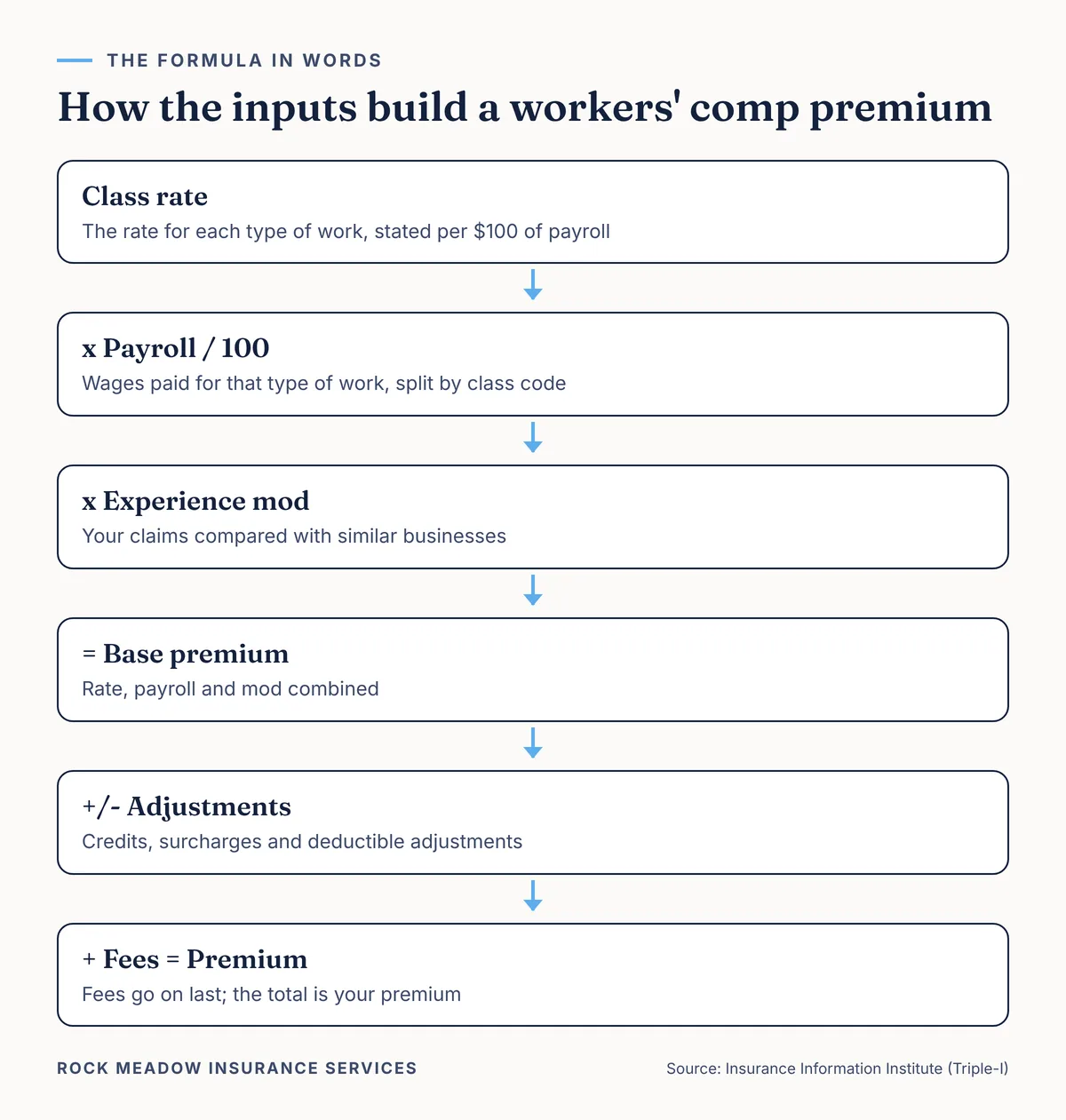
Insurers start with a rate for each type of work and apply it to your payroll. Then they adjust the result for your claims experience. In words, the formula looks like this:
Class rate x (payroll / 100) x experience mod = base premium
Credits, surcharges (an extra charge) and deductible adjustments then move the base up or down. Fees go on last, and the total is your premium.
Insurers state workers’ comp rates per $100 of payroll, so the rate next to each class code is the price for every $100 of wages in that job. A higher rate means each wage dollar costs more to insure.
Where your people work matters too. Each state sets its own benefit levels and runs its own system. Where benefits are richer or the system runs less efficiently, premiums can be higher. Being located in an area at high risk of catastrophe can add cost as well.
Each input has its own place on a quote:
| Input | What it measures | Where it shows on a quote | What moves it |
|---|---|---|---|
| Class rate | The injury risk of a type of work | Next to each class code | The job duties in that code |
| Payroll | Wages paid for each type of work | By class code, as an estimate | Hiring, raises, overtime and role changes |
| Experience mod | Your past claims compared with similar businesses | One factor, labeled "mod" (also called EMR) | How many claims you had and how large |
| State and location | Benefit levels and the system where work happens | A state listed by code or location | Where your employees work |
| Credits and surcharges | Adjustments for programs or added risk | Lines below the base premium | Programs you join and the insurer’s rules |
| Deductible | The part of each claim you agree to pay | A deductible line, if you chose one | Whether your state and insurer offer one |
| Fees | Charges added on top of premium | Near the bottom of the quote | State and insurer rules |
The premium isn’t the whole cost, either. Total cost also includes deductible payments and the administrative work of handling claims. Triple-I’s guide to how workers’ comp premiums are set covers these costs in more detail.
Class code and payroll set the starting point, so look at them next.
What do class codes and payroll mean?
Class codes
A class code is a number that stands for one type of work. Each code has its own rate. Jobs with more injury risk, like trash hauling or logging, carry higher rates than work at an accounting firm.
One business can have more than one code. An office manager and a field tech at the same company can sit in different workers comp class codes. Payroll is then split across the codes by role. That way, each person’s wages are priced at the rate for the work they do.
This is why a builder, a cafe and a shop start from such different places. Our pages on coverage for contractors and trades, coverage for restaurants and coverage for retail stores each deal with a different mix of jobs. For one trade up close, see where workers’ comp fits for HVAC contractors, next to their liability coverage.
The class codes are the first thing to check on a quote. Triple-I’s advice is to make sure your premium is figured correctly. If a code doesn’t match what someone actually does, ask your agent to explain it.
Payroll
Payroll here means the wages paid for each type of work. State rating rules decide which kinds of pay count, and overtime is one item that gets adjusted. At the start of the term, payroll is only an estimate, and it gets checked against real numbers later.
Whether owners or officers count toward payroll is set by state rules too. Forming an LLC is a separate question from who counts for workers’ comp. Our article on what an LLC protects and what it doesn’t covers that side.
Rate and payroll set the base. Your claims history then moves it up or down.
How do claims and assigned risk affect the price?
Claims and your mod
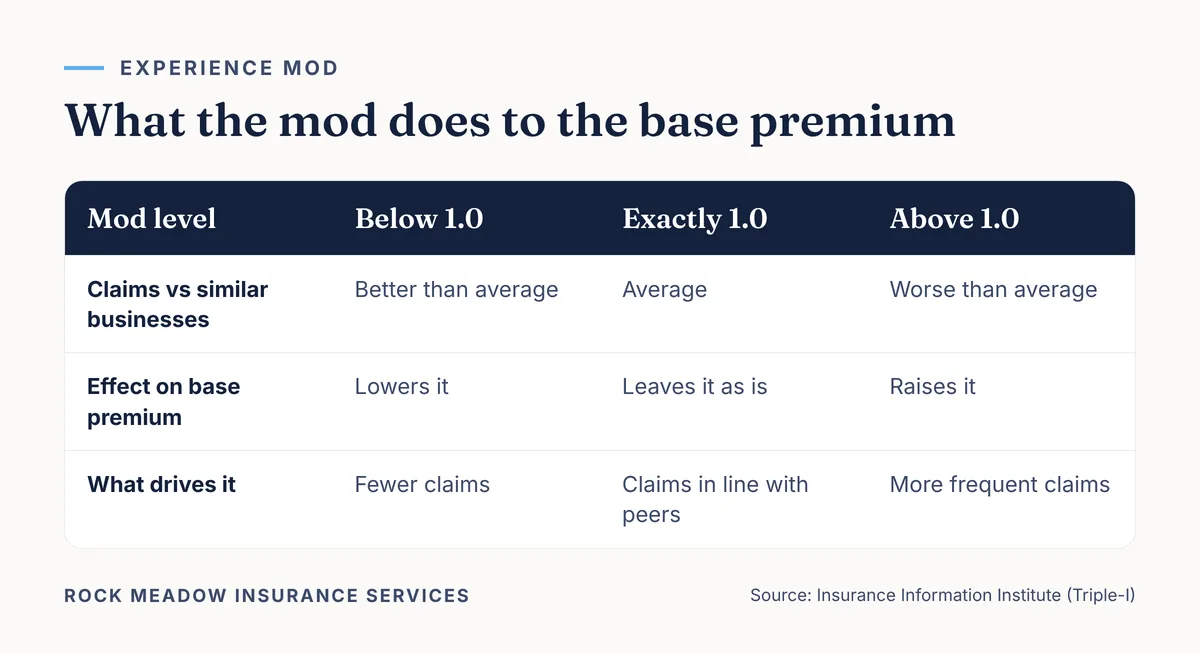
An average business has a mod of 1.0. A mod below 1.0 lowers your base premium, and a mod above 1.0 raises it. The mod, short for experience modification rate, compares your claims with those of similar businesses in your industry. A new business with no claims history to compare may not have one yet.
How often claims happen matters more than their size. Triple-I puts it as "frequency breeds severity": many small injuries point to the conditions that lead to bigger ones. That’s why the mod pays close attention to how often claims happen.
Assigned risk and state funds
Private insurers sell workers’ comp, and some states also run a state fund that sells it. A business that can’t get a policy from a private insurer or a state fund can turn to an assigned risk plan. That plan is the insurer of last resort. Assigned risk workers comp often carries a surcharge on top of the premium.
So the same class codes, payroll and mod can price differently depending on where the policy is placed. If you aren’t sure where yours sits, ask your agent whether your policy is placed in assigned risk.
All of this starts as an estimate, and the audit settles it.
Why did the audit change my bill?
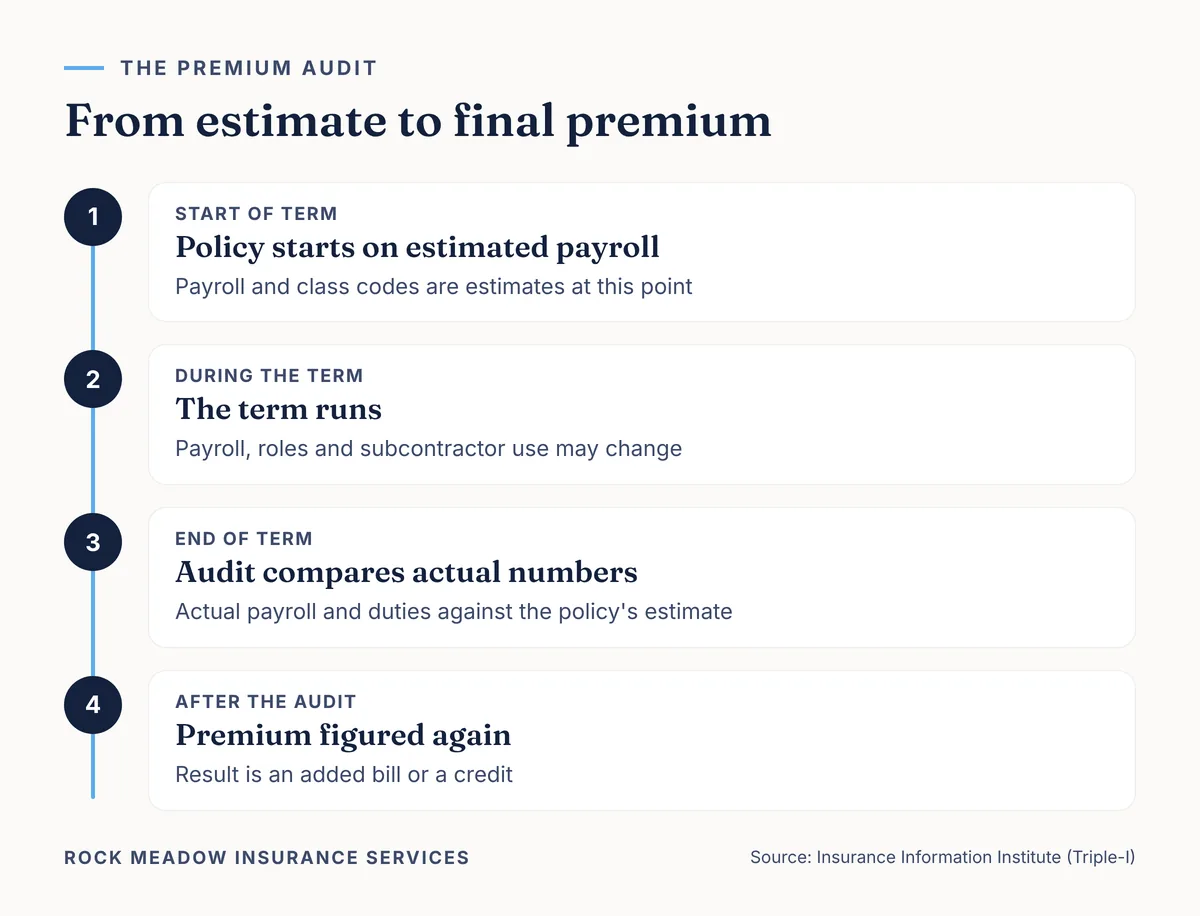
The estimate from the start of the term gets checked once the term ends. That check is the workers comp premium audit. An auditor compares the payroll and class codes on your policy with your real payroll and the duties people actually did. The premium is then figured again on the real numbers.
A few things can push the bill up. Payroll grew during the year. A worker’s role shifted into a code with a higher rate. Or you used subcontractors who had no coverage of their own.
In most states, an uninsured subcontractor or its workers may be treated as your employees, so keep proof that each sub has its own coverage. If payroll came in lower than the estimate, the change can run the other way, as a credit.
Good records make the audit go smoother. Keep these on hand through the year:
- Payroll broken out by role
- A short note of each person’s job duties
- A certificate of insurance from every subcontractor you hire (a one-page proof that the sub has its own coverage)
Our article on how a certificate of insurance works explains what one shows. If a contract asks you for a certificate, additional insured vs certificate holder explains the two kinds of requests.
If a code on your audit statement looks wrong, ask your agent to walk through it with you.
The audit also shows which inputs sit in your hands, and that’s where owners have some room.
How to lower premiums and prepare a quote
What owners can influence
Owners can’t set the rate for a class code, but they can shape some other inputs. Triple-I lists ways to lower workers comp premiums over time. The first three are open to almost any business:
- Check that the premium is figured right. Make sure you’re in the right class, and that payroll is split by role and adjusted for overtime.
- Manage your risks. Fewer injuries mean fewer claims feeding into the mod. That pays off slowly, through your record, not as a discount up front.
- Plan for early return to work. A way back to the job, even with light duties, is part of managing a claim.
The rest depend on your state and your insurer. They may be offered, but you’ll need to ask your agent:
- Deductibles. Some states allow an optional deductible, where you pay part of each claim. Your insurer may offer one.
- State premium credits. Some states give credits, such as for a safety program. Your agent can tell you whether your policy qualifies.
- Coordinated disability programs. In some states, businesses link workers’ comp with health and disability plans.
Reporting an injury right away also helps. The claim gets handled early, and the worker gets care sooner. None of these steps sets a price, so ask your agent which options your state and insurer actually offer before counting on any of them.
What to have ready
A quote is only as good as the details behind it. Gather these before you ask:
- Job duties for each employee, a sentence or two each
- Payroll by role, past and expected
- Your current or prior policy
- Loss runs, the insurer’s report of your past claims
- Which subcontractors you use, with their certificates of insurance
- Every state where your employees work
When a policy is issued, its documents decide what is covered and how it’s rated, so read the policy itself, not only the quote.
When you request a workers’ comp quote, the first two items on that list matter most. If you’re pricing both at once, you can also quote a business owner’s policy alongside workers’ comp.
With these papers in hand, you can read your own quote line by line: the codes, the payroll, the mod and every charge below them.
Common questions
How much will workers comp cost me per employee?
There’s no set price per employee. Premiums rest on payroll and the kind of work, so each person’s pay and job class matter more than head count. For a new business, the number of employees can be a factor too. An office worker’s pay sits in a lower-rated class than pay for riskier field work, like logging or trash hauling.
How do I lower my experience mod?
Fewer claims is the main lever, since the mod reacts more to how many claims you have than to how large they are. A safety program and quick injury reporting work on that count over time. The mod is rebuilt from your record, so it moves as that record changes, and no single step promises a lower one.
Why does my workers comp audit say I owe more?
The audit re-priced your policy on what actually happened, and that came in above the estimate. Look for three things on the statement: payroll by class code, any code that changed and any subcontractors listed without proof of coverage. Ask your agent which lines moved.
Is workers comp included in my business owner’s policy?
No. Workers’ comp is written on its own policy, apart from a BOP. The BOP packages property and liability coverage for the business itself. Workers’ comp is aimed at job injuries to your own staff. If you want both, you can price them side by side when you ask for a quote.
What does it mean if I’m in assigned risk workers comp?
It means your policy came from the plan of last resort, not the regular market. That plan is there for businesses that can’t find coverage elsewhere. It often adds a surcharge to the premium. Ask your agent what the regular market looks for, and whether a move back is possible at renewal.
Do I need workers comp if I run a one-person business?
It depends on where you work. Workers’ comp laws differ by state. Each state’s agency writes its own rules, and those rules decide whether a sole owner with no employees counts as a covered worker. Your first hire can change the answer, so look at it again when your team grows.
Where we help
Clients across California and nationwide work with Rock Meadow Insurance Services. To get going, start a workers’ comp quote with your job duties and payroll by role, so we know which class codes to ask insurers about. If you’d like to talk first, call (760) 654-6760 or contact our team to set up a time to go over your questions about rates, codes or your mod. There’s no pressure to buy.
Sources
- Workers compensation insurance (Insuring Your Business: Small Business Owners’ Guide to Insurance), Insurance Information Institute (Triple-I). Supports the general explanations of how premiums are set (a rate for each type of work applied to payroll, then adjusted for claims experience); how state benefit levels, system efficiency and catastrophe exposure affect cost; deductibles and admin time; the Part One and Part Two structure and Other States coverage; "frequency breeds severity"; state funds and assigned risk plans as the insurer of last resort, often with a surcharge; uninsured subcontractors counted at audit; and the steps it lists for lowering premiums.
- Get business insurance, U.S. Small Business Administration. Supports the point that laws requiring business insurance vary by state, and the pointer to check with your state.
- Small business insurance, National Association of Insurance Commissioners. Supports that workers’ comp is not part of a business owner’s policy, and that for a new business premiums may be based on payroll, number of employees and type of work, plus safety history for an established business.
Coverage, limits, exclusions and eligibility vary by policy and insurance company, and the policy documents decide what is covered. This article is general information, not legal or tax advice; confirm licensing, bond and workers' compensation requirements with the agency that applies to your business.