
Reviewed by Anthony Howe, Licensed Insurance Agent, NPN #20649362, CA License #4281027 on 2026-11-11
What this article covers: We follow one two-van HVAC company through its work. A furnace install, a rooftop swap and a leak that shows up weeks later show what general liability is for. The policy’s edges come into view with a faulty install, the crew, vans, tools, a refrigerant release and a design mistake, along with the policies that often pick up each gap. You’ll also see who asks for proof of coverage, a California licensing example and three ways to buy.
What is general liability insurance for HVAC contractors?
A property manager just emailed you. Before your crew swaps a rooftop condenser for a strip-mall tenant, they want proof of general liability. Or you’re starting a new HVAC company, and that line sits on every checklist you find.
General liability typically pays for claims that your work hurt someone else or damaged their property. It often pays your legal defense too, subject to the policy’s terms, limits and exclusions.
The full name is commercial general liability, or CGL. Liable means legally responsible. CGL protects your business when you’re held liable for harm caused by your operations or your employees. That harm can be bodily injury, property damage, or personal and advertising injury.
CGL covers non-professional negligent acts. Those are careless mistakes on the job, not errors in expert advice. The claims come from third parties. A third party is anyone outside your business, like a customer, a tenant or someone walking by, and not you or your employees.
Say you run a two-van HVAC company. You install furnaces, swap rooftop units and run service calls. Every one of those jobs puts your crew inside someone else’s home or building, close to someone else’s things.
Our page on hvac contractor insurance covers the full set of policies an HVAC business may carry. Here we stay on the edges of general liability insurance: what it does and where it stops. So what does the policy pay for when something goes wrong on one of those jobs?
What it typically covers on HVAC jobs
A standard CGL policy has three parts, called Coverage A, B and C.
Coverage A is for bodily injury and property damage to others. Picture the furnace install in a finished basement. A homeowner trips over a hose your tech ran down the stairs, or the old unit gouges the ceiling on its way out. Those are Coverage A claims.
When a covered claim comes in, the policy typically pays for your legal defense, subject to its terms. It also pays damages you’re found liable for, up to the policy’s limits and subject to its exclusions. A limit is the most the policy will pay.
Coverage B is for personal and advertising injury. It covers claims that you harmed someone’s name with false and damaging statements. It also covers claims that you used another company’s ad idea or copied their copyrighted work. Your website, flyers and van wraps all count as advertising.
The Insurance Information Institute (Triple-I) lists the full set in its Triple-I guide to commercial general liability insurance.
Coverage C is medical payments. It pays smaller medical bills for someone who isn’t your employee and gets hurt at your place of business or by your work. Nobody has to prove you were at fault, and nobody has to sue.
| Coverage part | What it is for | HVAC job example |
|---|---|---|
| Coverage A | Bodily injury and property damage to others, plus legal defense | A homeowner trips over a hose during a basement furnace install |
| Coverage B | Personal and advertising injury, such as false statements that harm a name or using another company’s ad idea | A flyer that borrows a competitor’s ad idea |
| Coverage C | Smaller medical bills for a non-employee, paid without a lawsuit | A tenant bumps a ladder near the rooftop hatch and needs stitches |
After the job is finished
Say a condensate line you installed starts leaking weeks after your crew leaves. Water stains the ceiling below and ruins a tenant’s carpet. Claims that come up after a job is finished fall under completed operations. HVAC work can cause trouble long after the van pulls away, so confirm this coverage is on your policy.
Knowing what the policy covers only helps if you also know where it stops.
What does general liability leave out?
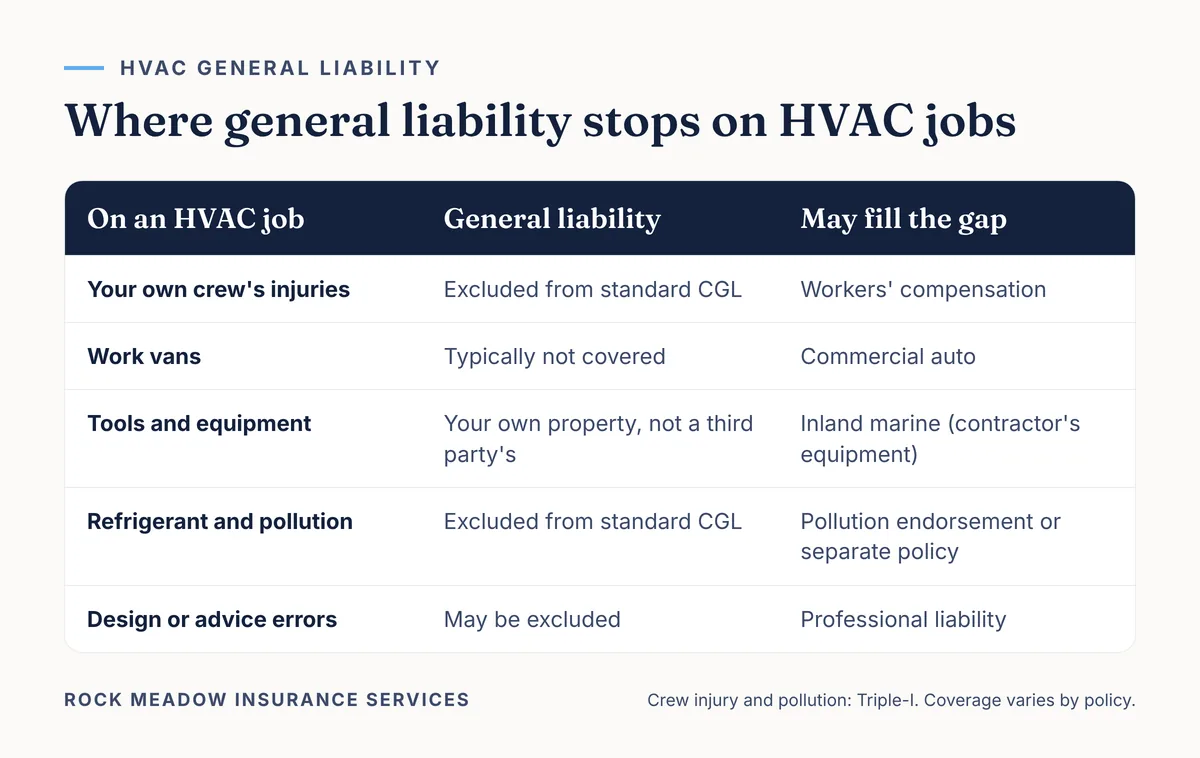
General liability has firm edges. Some are exclusions, which are things the policy names as not covered. Others are simply outside what the policy was built to do. For the two-van company, the gaps look like this.
| Gap | HVAC example | Policy that may fill it |
|---|---|---|
| Your own work | Redoing a furnace install that failed | General liability isn’t built for this; see below |
| Employee injuries | A tech hurts their back lifting a condenser | Workers’ compensation |
| Vans | A work van backs into a customer’s car in the driveway | Commercial auto |
| Tools and equipment | Gauges and a vacuum pump stolen from a van | Inland marine (contractor’s equipment); commercial property at the shop |
| Pollution | Refrigerant released during a system swap | A pollution endorsement or a separate pollution liability policy |
| Design or advice errors | A system sized wrong for the house | Professional liability |
Your own work needs a closer look. The policy is built for damage to other people’s property. So it generally won’t pay to fix or replace a faulty install itself. If that install then floods a customer’s basement, the water damage is a separate question for the policy wording.
Workers’ compensation exposures, meaning injuries to your own crew, are excluded from standard CGL. Those belong to workers’ compensation insurance, which is sold as its own policy. Driving is another gap. Crashes on the way to a job typically fall under commercial auto coverage, not general liability.
Your tools and stock are your own property, not a third party’s. At your shop, commercial property insurance may cover business property. Tools that ride along on the vans often need an inland marine policy, sometimes called contractor’s equipment coverage.
Pollution is excluded from standard CGL. You can add some of it back with an endorsement, a written change to the policy, but that coverage is very limited. Triple-I suggests that higher-risk businesses consider a separate pollution liability policy. A refrigerant release during a swap is one reason HVAC owners ask about it.
Professional liability may also be excluded. That matters if your company sizes systems or lays out ductwork. A mistake there is about your advice, not an accident on site.
Once you know the gaps, the next question is who wants to see your coverage, and in what form.
Who asks for proof, and how does it work?
Back to that rooftop condenser swap. Before your crew climbs up, the property manager wants proof of coverage. Homeowners, general contractors and commercial tenants may ask for the same thing. These requests come from the client or the contract, and contracts often ask for proof before any work starts.
What each client wants depends on its paperwork. Sometimes you work as a subcontractor, a company hired by the main contractor to handle one part of a bigger job. Then the general contractor’s contract drives the request. Our contractor insurance page shows how this plays out across the building trades.
Proof usually comes as a certificate of insurance. It’s a one-page summary of your policy that your agent issues. It shows the insurer, the coverage, the limits and the policy dates. A certificate shows what you carry, but it doesn’t change the policy.
Some contracts go a step further and ask to be added to your policy as an additional insured. That is a change to the policy made by endorsement, not just a name typed onto the certificate. What a specific clause asks for is a question for your attorney.
Requests to the insurer, such as a certificate or an endorsement, go through your agent. If your policy is with Rock Meadow, our team turns certificate requests around quickly.
Clients aren’t the only ones who ask, though. Licensing boards can set insurance rules too, and one state shows how that works.
What does California’s licensing board ask?
This is one state’s approach, shown as an example. Other states set their own rules. In California, contractors are licensed by the Contractors State License Board (CSLB), and HVAC work falls under the C-20 class for warm-air heating, ventilating and air-conditioning.
Liability insurance for LLC licensees
An HVAC company licensed as an LLC must carry liability insurance, with a minimum set by the number of people listed on the license. The policy has to come from an insurer licensed in the state or from an eligible surplus line insurer. A surplus line insurer is one that isn’t licensed in a state but is allowed to write certain policies there.
The LLC’s home improvement and service and repair contracts must also include its liability insurance details. The CSLB rules for LLC licensees list the full set.
Workers’ comp for C-20 licensees
This rule ties back to the employee gap, and how payroll and class codes set a workers’ comp premium is covered in a separate article. Active C-20 licensees must carry workers’ comp, or hold a valid self-insurance certification. The rule applies whether or not they have employees. The proof is a certificate filed with CSLB, and only an insurer licensed to write workers’ comp in the state can file it.
Coverage must be continuous, and a lapse leads to a suspended license. The CSLB workers’ compensation requirements page has the details.
Confirm current rules with CSLB. Our page on HVAC contractor insurance in California covers the state’s other coverage questions.
Whatever state you work in, the next step is choosing how to buy the coverage.
How to set up HVAC liability coverage
General liability can be bought three ways. It comes as a stand-alone policy, as part of a business owners policy (BOP) or as part of a commercial package policy (CPP). A BOP puts liability and business property coverage in one policy. A CPP combines several coverage parts that the business picks.
| Option | What it bundles | Often fits | Trade-off |
|---|---|---|---|
| Stand-alone general liability | Liability only | Companies that already have property coverage or work mostly out of their vans | Simple to set up and change; other coverage is bought and tracked separately |
| Business owners policy (BOP) | Liability and business property in one policy | Many small businesses; the insurer decides who qualifies | One package to manage; less room to adjust, and some operations don’t fit |
| Commercial package policy (CPP) | Liability plus parts you choose, such as property or inland marine | Larger or more complex operations | More room to adjust; more pieces to review at renewal |
Our business owner’s policy page explains what a BOP includes and who may qualify. On top of any of these, an umbrella policy is a separate excess policy that adds more protection when the limits underneath aren’t enough.
Price comes down to the type of work, payroll, revenue, location, the limits you pick and your claims history. Business insurance rates can vary a lot from place to place. The SBA guide to business insurance covers how location shapes business costs.
Before you buy or renew, a few points are worth checking with your agent. The policy documents decide what is covered, so get the answers in writing:
- Which coverage parts (A, B and C) are on the policy
- Whether completed operations is included
- How the pollution exclusion reads, and whether an endorsement adds anything back
- What workers’ comp, commercial auto and tools coverage you have in place
- What your biggest clients’ contracts ask for
- Who issues your certificates, and how you request one
If you’re shopping for coverage, you can request a quote.
Common questions
Is general liability the same as a business owner’s policy?
No. A BOP is a package that includes general liability; general liability can also be bought on its own. Think of general liability as one piece and the BOP as a bundle that holds it. The insurer decides whether your HVAC company qualifies for a BOP.
How much general liability coverage do I need for my HVAC business?
There’s no single number. Your limits often start with what clients and contracts ask for. A contract may set a minimum before work begins. Licensing boards can set a minimum too, as the California example shows. Your agent can walk through limit options side by side, and an umbrella policy can add more on top.
If refrigerant leaks at a customer’s home, will my general liability respond?
It depends on how your policy treats pollution. Look for the pollution exclusion in your policy documents. Then check whether an endorsement adds some back, or whether you carry a separate pollution liability policy. Your agent can show you where each one sits. Ask for the answer in writing before your next system swap.
Does my general liability cover damage my van causes on a job site?
Typically not. Damage caused by driving or using a work van is the job of commercial auto coverage. That could be a van backing into a customer’s fence while you park for a service call. Some moments, like unloading a parked van, can be less clear. Ask your agent how your auto and liability policies split them.
Do I still need general liability if I only do service calls, not installs?
Service-only work still carries the same kinds of third-party risk, just on shorter visits. Your techs still work inside other people’s homes and buildings, near their floors, walls and things. A property manager or homeowner may still ask for proof before a service call. The choice is yours, and your agent can show how coverage changes for service-only work.
Where we help
Rock Meadow Insurance Services works with clients across California and nationwide. We help HVAC companies compare general liability and the policies around it, including workers’ comp, commercial auto and equipment coverage. To get started, request a business insurance quote.
If your policy is with Rock Meadow, our team provides fast certificates of insurance when a client asks for proof. If you’d rather talk it through, call (760) 654-6760 or contact a licensed agent. There’s no pressure to buy.
Sources
- Commercial general liability insurance, Insurance Information Institute (Triple-I). Supports what a commercial general liability policy covers (Coverage A, B and C, plus legal defense and damages up to the limits), what it leaves out (injuries to your own employees, pollution, and possibly professional liability) and how it is bought (stand-alone, in a business owners policy or a commercial package policy, with an umbrella policy on top).
- Get business insurance, U.S. Small Business Administration. Supports that business insurance rates vary by location.
- Limited Liability Companies (LLC), Contractors State License Board (California). Supports the California example: LLC licensees must carry liability insurance with a minimum set by the number of people listed on the license, written by a California-licensed or eligible surplus line insurer, and their home improvement and service and repair contracts must include the insurance details.
- Workers’ Compensation Requirements, Contractors State License Board (California). Supports the California example: active C-20 (warm-air heating, ventilating and air-conditioning) licensees must carry workers’ comp or a valid self-insurance certification whether or not they have employees, the insurer files the certificate with CSLB, and a lapse in coverage leads to license suspension.
Coverage, limits, exclusions and eligibility vary by policy and insurance company, and the policy documents decide what is covered. This article is general information, not legal or tax advice; confirm licensing, bond and workers' compensation requirements with the agency that applies to your business.