If you’re a Californian, or an adult child helping a parent, and a breach notice or scam call has you wondering what an identity theft insurance plan pays for, this is for you. We cover what the insurance reimburses, what it usually excludes, and free steps anyone can take.
Reviewed by Anthony Howe, Licensed Insurance Agent, NPN #20649362, CA License #4281027 on 2026-10-25
What this article covers. We start with the three parts often sold together: monitoring, restoration help and the insurance itself. Then we walk through which expenses a plan usually reimburses, how deductibles, limits and your homeowners or renters policy shape what you get back, and whether plans reimburse stolen money. Next comes what monitoring can miss, the free options side by side, and six questions to ask about any plan. We close with what our identity protection includes and the first steps if your identity is stolen.
An identity theft insurance plan reimburses recovery costs, while monitoring and restoration help are separate pieces
An identity theft insurance plan reimburses certain out-of-pocket costs of recovering from identity theft, and it’s often one of three things sold together. Identity theft is when someone uses your personal or financial information without your permission. According to the FTC, this kind of insurance may help pay expenses you take on while you recover.
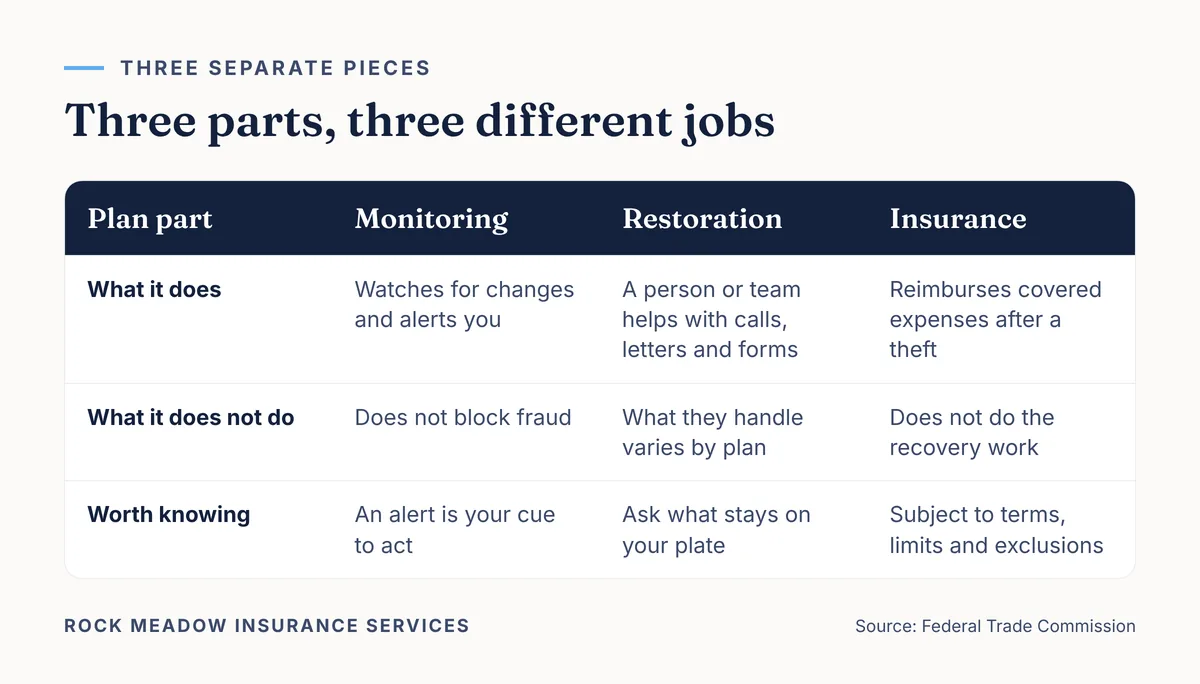
Here’s what each part does, in plain terms:
- Monitoring. It watches for changes, such as a new credit inquiry or account, and sends an alert when it spots one. Monitoring doesn’t block fraud; what happens next is up to you.
- Restoration help. A person or team who helps with the calls, letters and forms after a theft. What they handle, and what stays on your plate, varies by plan.
- Identity theft insurance. Reimbursement of covered expenses after a theft, subject to the policy’s terms, limits and exclusions. It pays back costs; it doesn’t do the recovery work.
Is identity theft insurance the same as credit monitoring? No, they do different jobs. Monitoring tells you something changed; insurance pays back certain costs afterward. Some plans bundle all three, and others sell them separately.
For a plain-language overview of what identity theft looks like and how it’s reported, see FTC: what to know about identity theft. Knowing which part you’re paying for makes plan terms easier to read, so ask any plan which of the three it includes.
Identity theft insurance may cover recovery costs, lost wages and legal fees, depending on the plan
Identity theft insurance may cover recovery costs, lost wages and legal fees, depending on the plan; those are the categories the FTC lists. Put simply, it pays back some of what it costs you to clean up after someone uses your identity. What counts as a "covered expense" is spelled out in the policy wording, and plans vary on that definition.
| Expense type | What the FTC says | What to check in writing |
|---|---|---|
| Recovery costs | May be covered | The exact list of covered expenses and any per-item caps |
| Lost wages for time off to handle the theft | May be covered | Any daily or total caps, and what proof of lost pay the plan accepts |
| Legal fees | May be covered | Which legal costs count, and whether the insurer has to approve them first |
| Money scammers stole | Generally not reimbursed | Whether stolen funds are a covered loss at all |
Your policy may name specific items within each category, or leave some out. Stolen money gets its own section below, because that is where expectations and policy wording tend to part ways.
Legal fees show up here only as a possible covered expense. Whether a dispute needs a lawyer is a separate question; the plan’s terms decide what it reimburses.
Before you compare plans, ask for the policy’s covered-expense list in writing and read it next to any ad or summary. If the two don’t match, the policy wording is what counts.
Deductibles, coverage limits and your homeowners or renters policy shape what a plan pays
What you get back from an identity theft insurance plan depends on its deductible, its coverage limit and the exclusions written into the policy. The FTC says this insurance may pay some out-of-pocket costs of cleaning up after identity theft but generally doesn’t pay back stolen money.
Four terms shape the number:
- Deductible. The amount you cover yourself before reimbursement starts. Some plans have one and some don’t, so check the amount and whether it applies per claim.
- Limit wording. The headline limit is the most the plan pays overall. Some policies set smaller limits for categories like lost wages or legal fees, so not every expense is reimbursed up to the headline figure.
- Exclusions. The losses and situations the policy doesn’t cover. Read this list next to the covered-expense list; together they define a claim.
- Existing coverage. Some homeowners or renters policies include identity theft coverage or offer it as an add-on. That may be worth checking, along with how the two would work together.
To see what you already have, look at your homeowners insurance or renters insurance declarations page (the summary page at the front of your policy that lists coverages and limits), or ask your carrier in writing whether identity theft coverage is included and what its limits are.
Most identity theft insurance does not reimburse stolen money
Per the FTC, identity theft insurance generally won’t reimburse you for money scammers stole. If someone empties a checking account or runs up charges on a card, the insurance usually isn’t what pays that back.
That’s because the coverage is built around recovery. It reimburses certain costs of putting your records back in order, not the money that was taken. Plans vary, so the policy wording is where you find out whether stolen funds count as a covered loss at all. An ad or a sales page isn’t a substitute for that wording.
Stolen money is usually handled a different way. The usual route is to report unauthorized charges or withdrawals to the bank or card issuer, which has its own process for reviewing them. How that review goes depends on the account and the institution, so we keep this general: ask the bank directly what it needs from you and by when.
Before you sign up for any plan, ask one plain question: "Are stolen funds a covered loss, and under what conditions?" Get the answer in writing, from the policy or plan documents.
Monitoring alerts you to some changes, and it can miss activity outside your credit file
Monitoring alerts you to activity it can detect, like a new credit inquiry or a newly opened account, but it does not block fraud on its own. An alert is a prompt to act, not protection by itself.
What a service can see depends on the data it watches, and some services lean mainly on your credit file. Some identity theft never touches it. The FTC lists warning signs that can show up outside a credit file, such as bills or charges you didn’t expect and withdrawals you didn’t make.
Other kinds of misuse may not reach a credit file either. As general examples, not drawn from the FTC’s list: a tax return filed in your name, misuse of government benefits, someone using your information to get medical care, or a debt collector calling about a debt you don’t recognize. Any of these may surface first as a letter, a bill or a phone call rather than an alert.
So we treat alerts as one signal among several. Read your bank and card statements, your tax mail and any benefit notices when they arrive. If a plan includes monitoring, ask in writing which sources it actually watches.
Credit freezes, fraud alerts, free credit reports and IdentityTheft.gov cost nothing
A credit freeze, a fraud alert, your credit reports and the self-help tools at IdentityTheft.gov are all free, and each one does a different job.
| Free option | What it does | How long it lasts | What it takes |
|---|---|---|---|
| Credit freeze | Blocks new credit from being opened in your name until you lift it | Until you lift it | A request to each bureau: Equifax, Experian and TransUnion |
| Initial fraud alert | Asks businesses to verify your identity before opening new credit | One year | Contact one bureau, which tells the other two |
| Extended fraud alert | The same verification step, for people whose identity has been stolen | Seven years | An FTC identity theft report or a police report |
| Free credit reports | Shows the accounts and inquiries each bureau has on file | Available every week | A request at AnnualCreditReport.com |
| IdentityTheft.gov self-help tools | Takes your identity theft report to the FTC and offers free, self-guided recovery resources | Not a setting that expires; you manage the steps yourself | An online report at IdentityTheft.gov |
You request freezes, alerts and reports directly from the bureaus or the government sites; nobody needs to sign you up. The official pages, FTC: credit freezes and fraud alerts and CFPB: getting your free credit reports, walk through each request.
None of these tools reimburses recovery expenses, which is the insurance piece’s job. Some people use the free tools alone and some pair them with a plan. The mix depends on your situation.
For more free tools and official links, see our consumer resources page.
Six questions to ask about any identity theft insurance plan before you sign up
Six questions cover most of what separates one identity theft insurance plan’s terms from another’s. Ask them about any plan you’re comparing, ours included, and get each answer in writing, taken from the plan’s own documents rather than an ad.
- What is the coverage limit, and how is it worded? Look for "up to" language and any smaller limits for specific expense types.
- What is the deductible? Plans differ, so confirm the amount and when it applies.
- What counts as a covered expense? Ask for the actual list in the policy wording, not a summary.
- Are stolen funds a covered loss? The FTC notes that this kind of insurance is aimed at the cost of recovering, and that it generally doesn’t pay back money a scammer took. Ask whether this plan treats stolen funds as a covered loss and under what conditions, if any.
- What does restoration help include, and who does the work? Find out whether a person handles calls and paperwork with you, and how you reach them.
- Are family members covered? Ask who counts as family and whether each person has to enroll separately.
Ads that push you to sign up on the spot, or stay vague about terms, are a reason to slow down. The same pressure tactics show up in other insurance ads, and our piece on signs a free burial ad may be a scam walks through a few.
Bring the plan documents to anyone you trust and read them against these questions.
Rock Meadow’s identity protection pairs monitoring and restoration help with insurance for covered losses
What we offer has three parts: identity monitoring and alerts, restoration help, and identity theft insurance that reimburses covered losses, subject to the plan’s terms, limits and exclusions. It’s the same three-part setup described at the top of this article, sold as one plan.
The monitoring sends alerts about certain changes, like new credit activity; it does not block fraud. An alert is a prompt to check and act. Restoration help is included too; its scope is set in the plan documents, and we can confirm in writing what it covers.
The insurance works like the plans described above. It reimburses covered expenses, and we don’t describe it as paying back money scammers took. The coverage limit, the deductible and the list of covered expenses are set in the plan documents, and we can read them with you before you decide anything.
This is one option among several. The free steps above, like a credit freeze or a fraud alert, work on their own, and some people use them with a paid plan while others don’t. That choice is yours.
For plan details, see our identity protection coverage page or identity protection across California. To see who we are, read about Rock Meadow Insurance Services.
If your identity is stolen, the first steps are reports and freezes
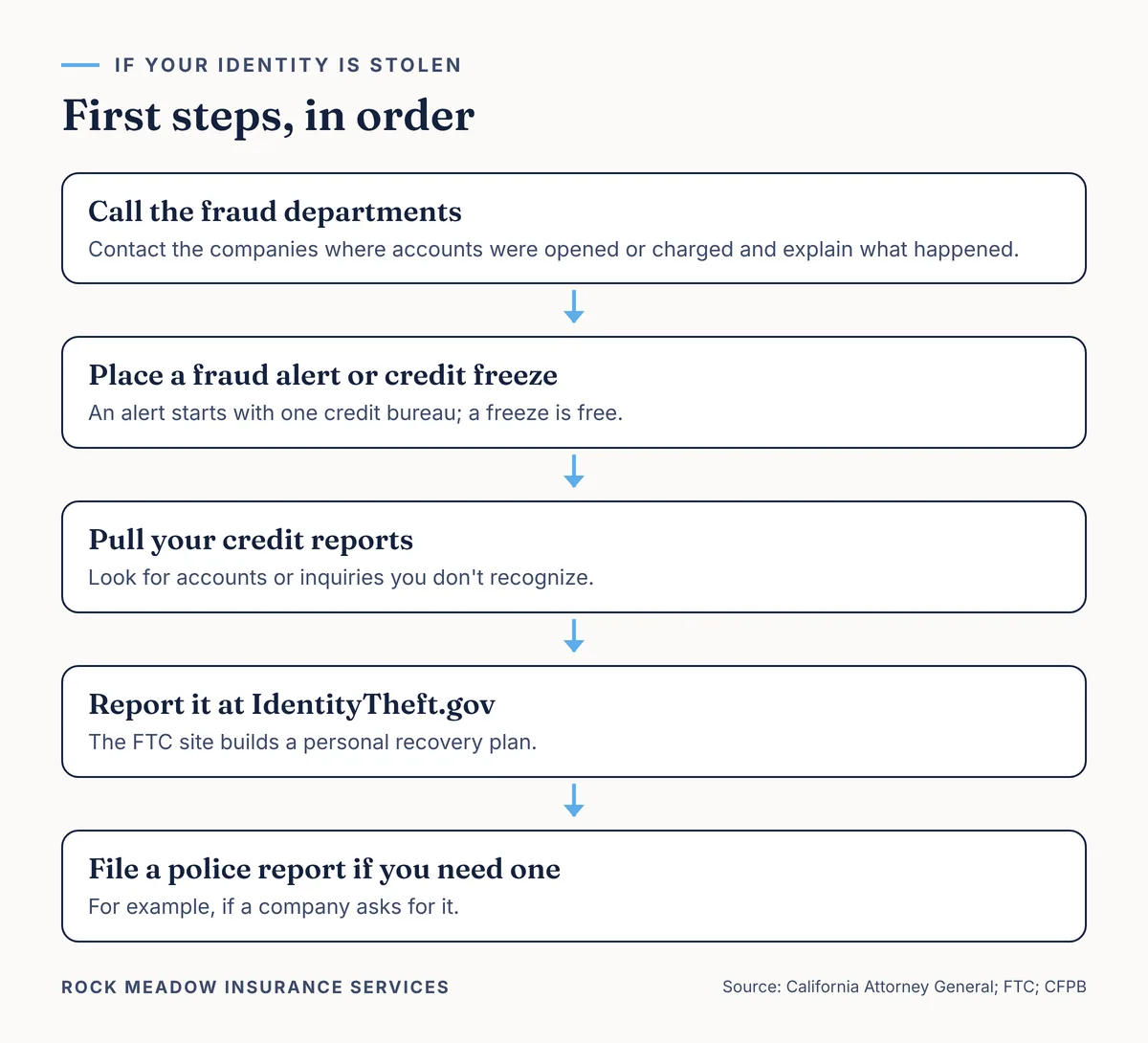
If your identity is stolen, start with the companies where the fraud happened, then the credit bureaus, then a report at IdentityTheft.gov. The California Attorney General’s first-aid page points to similar steps, such as contacting your bank or card issuer and placing a fraud alert or security freeze.
- Contact your bank or card issuer and dispute any charges you didn’t make. Note who you spoke with and when.
- Place a fraud alert or a credit freeze. An alert starts with one bureau, and a freeze is free. The free options table above has the details.
- Pull your free credit reports and check them for anything unfamiliar.
- Report it at IdentityTheft.gov. The FTC site takes your report and offers free, self-guided recovery resources.
- File a police report if you need one, for example if a company asks for it. A police report can also support an extended fraud alert.
The FTC also lists warning signs to watch for afterward, such as charges for things you didn’t buy, withdrawals you didn’t make or accounts you don’t recognize, and where to report them.
If you have an identity protection plan, you may want to ask its restoration help what records it needs, since reimbursement depends on the plan’s covered-expense list. Get that list in writing. For the state’s guidance, see the California Attorney General identity theft first aid page.
Checklist: Before you sign up for an identity theft insurance plan
Work through these eight steps before you sign up for any identity theft insurance plan.
- Pull your free credit reports and check each one for unfamiliar accounts or credit inquiries.
- Decide whether you want a credit freeze at all three nationwide credit bureaus, and note how you’d lift it later.
- Check your homeowners or renters policy, or ask your carrier, for identity theft coverage you may already have.
- Ask for the plan’s list of covered expenses in writing, not from an ad.
- Confirm the deductible and the exact wording of the coverage limit, including any per-category limits.
- Ask whether stolen funds are a covered loss, and get the answer in writing.
- Ask who provides restoration help, what it includes and how you reach them.
- Confirm whether family members, such as a spouse or a parent, are covered under the same plan.
Common questions
Is identity theft insurance the same thing as credit monitoring for me?
No. Credit monitoring watches your credit file and sends an alert when something changes, such as a new account; it does not block fraud. Identity theft insurance pays back certain recovery costs after a theft, under the policy’s terms, limits and exclusions. Some plans sell both together, so check which pieces a plan actually includes.
Do I need an identity theft plan if I already froze my credit?
It depends on what you want help with; the two do different jobs. While a freeze is on, new credit generally can’t be opened in your name. It doesn’t repay recovery costs or handle calls and forms for you. Some people stop at the freeze and some add a plan.
Does my homeowners or renters insurance already cover identity theft?
It might. Some homeowners and renters policies include identity theft coverage, and others offer it as an add-on. Your declarations page usually shows it if you have it. If it’s there, ask your carrier in writing what the limit is, what counts as a covered expense and how it would work alongside a separate plan.
Will freezing my credit hurt my credit score?
No. Per the FTC, a credit freeze doesn’t affect your credit score. It’s free, and it stays in place until you lift it. If you apply for a loan or card later, you’d usually lift it first at each bureau that has one, so keep any PIN or login the bureaus give you.
Can I cover my parent or other family members under one plan?
Sometimes. Family coverage depends on the plan’s terms: some plans include other household members, and others cover only the person enrolled. Ask who counts as a family member, whether a parent who lives elsewhere qualifies and whether everyone shares one limit. Get those answers in writing before anyone enrolls.
Where we help
Rock Meadow Insurance Services works with clients across California and nationwide. If you’d like to talk through anything in this article, call us at (760) 654-6760.
We also have pages for identity protection in San Diego, identity protection in Los Angeles, identity protection in Oceanside and identity protection in Carlsbad.
A licensed agent can go through a plan’s terms with you, including limits, exclusions and how it compares with the free steps above. Questions are welcome whether or not you sign up for anything. When you’re ready, you can contact a licensed agent.
Sources
- What To Know About Identity Theft, Federal Trade Commission. Supports what identity theft is; its warning signs, such as bills or charges you didn’t expect and withdrawals you didn’t make, and where to report them; and that identity theft insurance may cover recovery costs, lost wages and legal fees but generally won’t reimburse money scammers stole.
- What To Know About Credit Freezes and Fraud Alerts, Federal Trade Commission. Supports that a credit freeze is free, restricts access to your credit report until you lift it, is requested from each bureau and doesn’t affect your credit score; that an initial fraud alert lasts one year and starts with one bureau, which tells the other two; and that an extended fraud alert lasts seven years and requires an FTC identity theft report or a police report.
- How do I get a free copy of my credit reports?, Consumer Financial Protection Bureau. Supports that free credit reports from each nationwide bureau are available every week through AnnualCreditReport.com.
- Identity Theft First Aid, California Attorney General. Supports the first steps of contacting the fraud departments of your bank, card issuer or other companies involved, and placing a fraud alert or security freeze.
- IdentityTheft.gov, Federal Trade Commission. Supports that reporting identity theft there is free and that the site offers free, self-guided recovery resources.