
Reviewed by Anthony Howe, Licensed Insurance Agent, NPN #20649362, CA License #4281027 on 2026-11-13
What this article covers: Why an LLC still has insurance needs of its own, and a side-by-side look at what the LLC structure does and what business insurance is for. Then when a state, a client or a landlord asks you to carry coverage, and the coverage types LLC owners compare. One part covers owners who run the LLC alone or from home, and the article closes with what to gather before you ask for quotes.
Does an LLC need insurance?
You just filed the papers for your limited liability company (LLC), or you’re about to. Now the business is its own legal entity. And a fair question comes up: do I still need insurance?
Here’s the short answer. An LLC generally separates your personal assets from business debts and lawsuits, but it does not pay claims, so the business itself still needs insurance. Insurance laws vary by state, and businesses with employees generally must carry workers’ compensation. Workers’ compensation is insurance for employees who get hurt or sick because of their job.
It helps to keep two ideas apart. An LLC is a legal structure, a way to set up a business so it stands apart from you.
Insurance is a contract. It pays covered losses, subject to the policy’s terms, limits and exclusions.
So the two do different jobs. The LLC draws a line between you and the business. Insurance is how the business handles certain losses on its own side of that line. An LLC does not replace insurance, and insurance does not replace the LLC.
Our page on small business insurance explains how a business owner’s policy works. This article stays on the LLC question.
The shield is the part people tend to overestimate. So start with what it actually covers.
What does an LLC protect, and what not?
The shield is real, but it’s narrow. In most instances, an LLC keeps business debts and lawsuits from reaching your personal assets, like your house, car and savings. That’s its job: it protects you, not the business.
The LLC’s own bank account, equipment and inventory are still on the line. If someone sues the LLC, the LLC still pays for its own legal defense and any judgment against it. The structure does nothing for an employee hurt on the job. And it won’t repair or replace business property that’s damaged or stolen, or replace income lost while a covered loss keeps you closed.
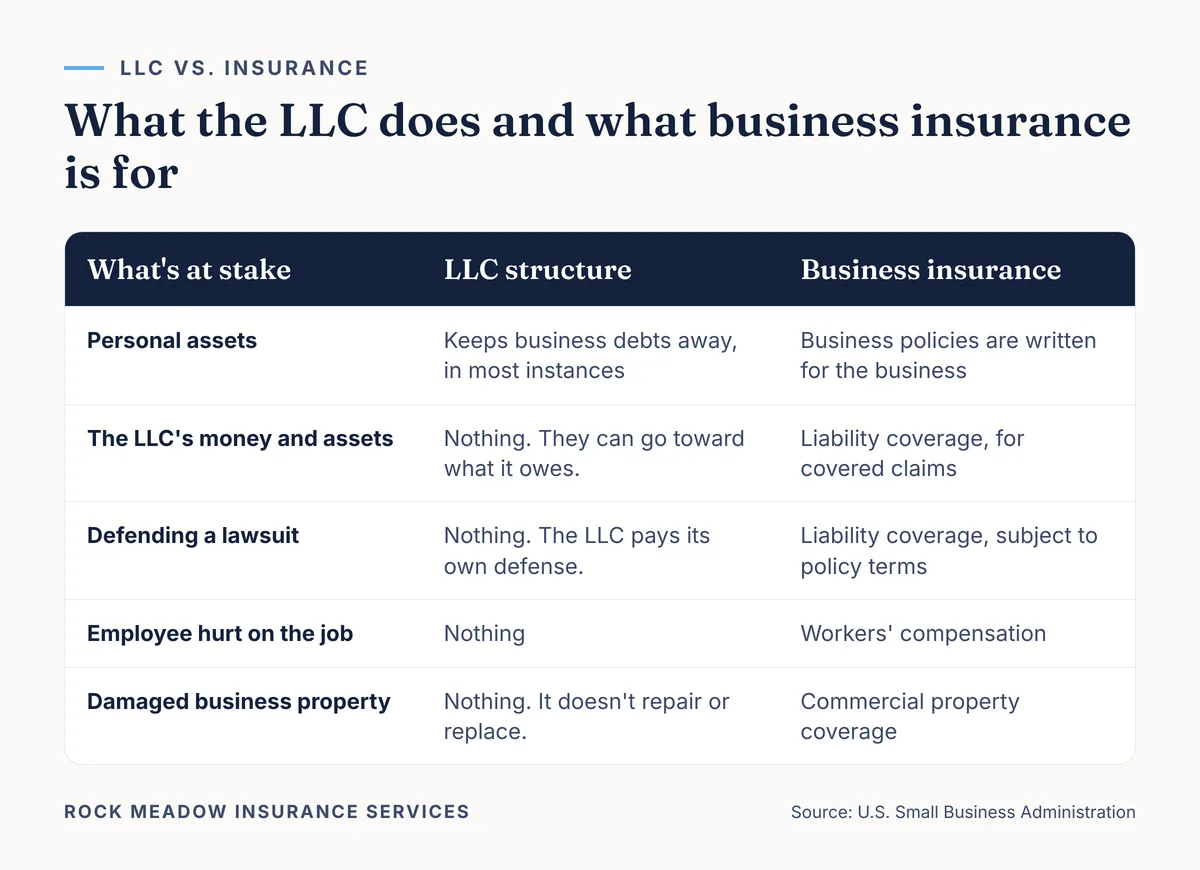
Each of those gaps lines up with a coverage type built for it. Here they are side by side.
| What’s at stake | What the LLC structure does | What business insurance is for |
|---|---|---|
| Your personal assets (house, car, savings) | Keeps business debts and lawsuits away from them, in most instances | Business policies are written for the business. Your home and car have their own policies. |
| The LLC’s money and assets | Nothing. What the LLC owns can go toward what it owes. | Liability coverage, such as general liability, is for covered claims made against the business. |
| Defending a lawsuit | Nothing. The LLC pays its own legal defense and any judgment. | Liability coverage is for covered claims, including defense, subject to the policy’s terms, limits and exclusions. |
| An employee hurt on the job | Nothing | Workers’ compensation |
| Damaged or stolen business property | Nothing. It doesn’t repair or replace property. | Commercial property coverage, on its own or inside a business owner’s policy |
Read the middle column again. Most rows say "nothing." That isn’t a flaw in the LLC. A legal structure was never meant to pay for losses. It only decides whose assets a business debt can reach.
Which structure fits your business depends on your situation. The U.S. Small Business Administration guide to choosing a business structure compares the LLC with other options. Questions about the entity itself, such as taxes or how it’s set up, go to an attorney or accountant.
Some of those gaps also come with rules. A state law or a contract may require you to carry coverage.
When is insurance required for an LLC?
The employee gap is where the law steps in first. Coverage can be required in two ways: by your state, or by the people you do business with.
When the state requires it
The SBA says businesses with employees are required by law to carry workers’ compensation insurance. That rule applies to an LLC the same way it applies to any other business. The details are set state by state.
So the answer for your LLC comes from your state. Your state’s workers’ compensation agency sets the rules and can tell you how they apply to you. For the national picture, the U.S. Small Business Administration guide to business insurance lists the main coverage types and the employer rules.
One question comes up a lot: who counts as an employee? If you pay contractors or part-time help, ask your state agency how its rules treat them. That call belongs to the agency.
When a client, landlord or contract asks
The other kind of "required" comes from paperwork, not law. Clients, landlords and contracts often ask for proof of coverage before work starts or a lease is signed. They may also name the coverage types they want to see.
Proof usually means a certificate of insurance, a one-page summary of a policy. Our guide covers what a certificate of insurance is and how to get one. A certificate shows coverage you already have. It doesn’t add anything a contract asks for.
Whether a policy meets a specific contract’s terms depends on the policy and the contract’s wording. Questions about what a clause means go to your attorney.
Once you know what’s required, the next question is which coverage types fit the rest of your business.
Which coverages do LLC owners compare?
These are the coverages that fill the gaps from the LLC table. Business insurance for LLC owners is built from a handful of common types. Each one is meant for a different kind of loss, so they’re easier to compare side by side.
For most LLCs, general liability insurance for an LLC is the starting point. It’s for claims that the business’s operations caused injury or property damage to someone else. Clients and landlords often ask to see it.
A business owner’s policy bundles liability coverage and property coverage into one policy. Many small businesses may qualify for a business owner’s policy. The insurer’s underwriting, which is its review of your business, decides.
For what the LLC owns, there’s commercial property insurance. It’s built for the LLC’s building, equipment and inventory. It protects the LLC’s own property. It isn’t meant for claims other people make against the LLC.
Professional liability, also called errors and omissions insurance, is for claims of mistakes or negligence in professional services. It’s aimed at businesses that give advice or provide a service to clients.
Workers’ compensation, from the last section, rounds out the list, and what sets a workers’ comp premium has its own article. The NAIC overview of insurance for small businesses explains these types in more detail.
| Coverage type | What it’s for | Who may ask for it | Where it fits | What it leaves out |
|---|---|---|---|---|
| General liability | Claims of injury or property damage to others from business operations | Clients, landlords, contracts | A common ask before work starts or a lease is signed | The LLC’s own property, employee injuries and professional mistakes |
| Business owner’s policy | Liability and property coverage in one package | Landlords and clients | One policy for two needs | Not every business qualifies; the insurer decides |
| Commercial property | The LLC’s building, equipment and inventory | Some leases | Businesses with property or equipment to protect | Claims others make against the LLC |
| Workers’ compensation | Employees who get hurt or sick from their job | State law, once you have employees; some clients | Businesses with employees | Injuries to people who aren’t your employees |
| Professional liability (errors and omissions) | Claims of mistakes or negligence in professional services | Clients who hire you for advice or a service | Consultants and other service businesses | Injury and property damage claims, which general liability is built for |
No single type does everything. That’s why owners mix and match. What makes sense depends on how the LLC runs, especially if it’s just you.
What if your LLC is just you?
A one-person or home-based LLC has the same gaps from the table near the top. Being small doesn’t close them. Two things do change the questions you’ll ask, though.
Single-member LLCs
A single-member LLC is one with just one owner. The LLC structure works the same way with one owner as with several. The business’s bank account and equipment are still on the line. Claims against the LLC generally still start with the LLC.
Workers’ compensation is where solo owners get stuck. Insurance laws vary by state, including how workers’ compensation treats an owner with no employees. Your state’s workers’ compensation agency can tell you how its rules treat you, and whether that changes once you hire.
Home-based LLCs
Running the LLC from your kitchen table or spare room adds a wrinkle. A homeowners or renters policy may not extend to business property or business liability. That can include the laptop you use for clients, inventory in the garage, or a client who visits.
Ask your agent how your home policy treats business use. From there, you’ll know if you need a change to your home policy or a separate business policy.
With a clearer picture of what you need, a little prep makes the quote stage go smoother.
Before you get LLC insurance quotes
Once you know which coverages fit, the next step is a request an insurer can quote. LLC insurance price is set by things like your industry, payroll, revenue, location, the limits you pick and your claims history.
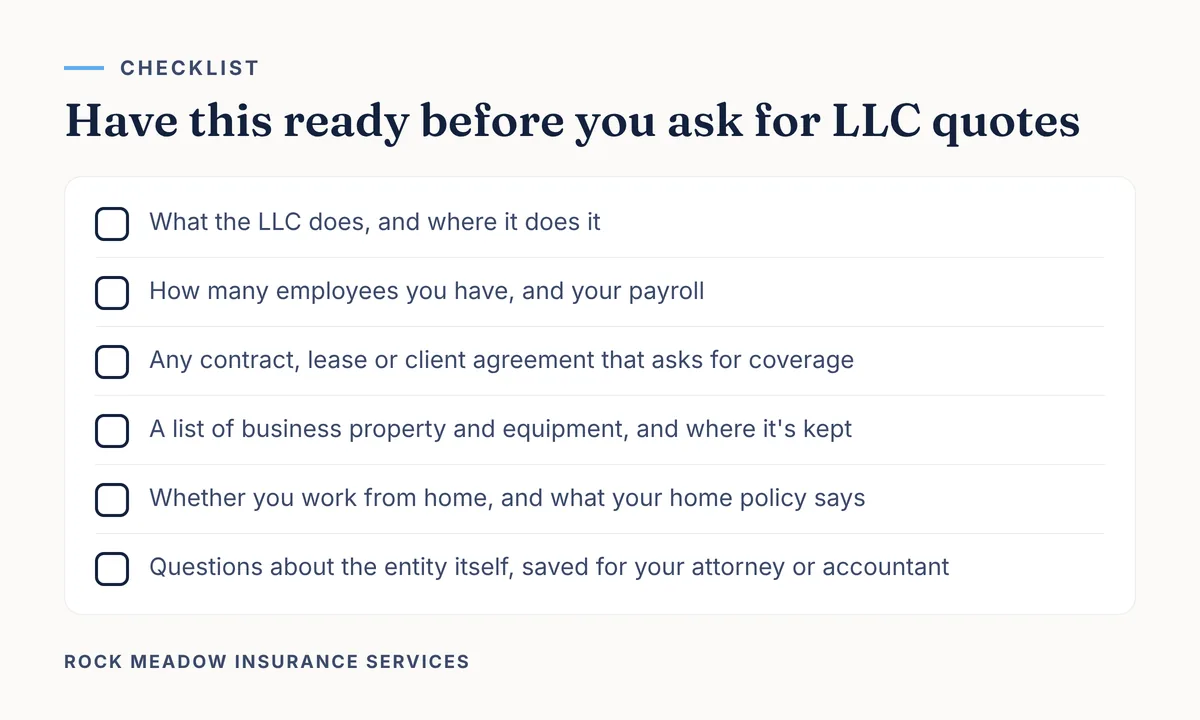
Here’s what to have ready:
- What the LLC does, and where it does it.
- How many employees you have, and your payroll.
- Any contract, lease or client agreement that asks for coverage. Note which coverages and limits it lists, so you can mention them on the quote form.
- A list of business property and equipment, and where it’s kept.
- Whether you work from home, and what your home policy says about business use.
- Any questions about how the LLC itself is set up, saved for your attorney or accountant.
When quotes come back, compare what each one includes and leaves out, not just the price. Coverage, limits and exclusions vary by policy and insurer, and the policy documents decide what is covered. Get answers to your coverage questions in writing before you sign.
With that list in hand, a quote request goes quickly.
Common questions
What sets the price of insurance for my LLC?
Insurers price LLC coverage from facts about the business. These include your industry, payroll, revenue and location. The limits you choose and any past claims play a part too. Each insurer weighs these in its own way. So the same LLC can get different quotes from different insurers for similar coverage.
Can one policy cover more than one LLC I own?
It depends on the insurer. Each LLC is its own legal entity. Insurers set their own rules on whether related businesses can be named on one policy or need separate ones. Ask your agent how a given insurer handles your LLCs. Get the answer in writing before you count on it.
Will my LLC qualify for a business owner’s policy?
It depends on your business. Many small LLCs may qualify, but the insurer’s underwriting decides. That review looks at things like what the business does, its size and its property. If an insurer says no, general liability and commercial property can also be bought as separate policies.
Do I need insurance before my LLC makes any money?
Insurance needs follow what the LLC does, not what it earns. A claim or a request for proof of coverage can come up as soon as the business operates. A signed lease or client agreement may ask for proof before your first sale. Hiring a first employee brings its own state rules.
Do I take LLC questions to an attorney, an accountant or an agent?
It depends on the question. Questions about how the LLC is set up, or what a contract clause means, go to an attorney. Tax questions go to an accountant. Questions about coverage types, limits and what a policy includes go to your insurance agent. This article is general information, not legal or tax advice.
Where we help
Rock Meadow Insurance Services works with clients across California and nationwide. To compare coverage for your LLC, you can request a business owners policy quote. If a contract or lease lists insurance requirements, keep that list handy when you fill in the form.
If your policy is with Rock Meadow, you can contact our team for coverage questions and certificates of insurance, which our team turns around quickly.
Rather talk it through first? Call us at (760) 654-6760. There’s no pressure to decide anything on the call.
Sources
- Choose a business structure, U.S. Small Business Administration. Supports the point that an LLC keeps business debts and lawsuits from reaching the owners’ personal assets in most instances, that this works the same way with one owner, and that the choice of structure depends on your situation.
- Get business insurance, U.S. Small Business Administration. Supports the points that insurance laws vary by state, that businesses with employees are required by law to carry workers’ compensation, and the descriptions of general liability, business owner’s policy, commercial property and professional liability coverage.
- Insurance for Small Businesses, National Association of Insurance Commissioners. Supports the general explanation of small business coverage types and the point that a homeowners or renters policy may not extend to business property or business liability.
Coverage, limits, exclusions and eligibility vary by policy and insurance company, and the policy documents decide what is covered. This article is general information, not legal or tax advice; confirm licensing, bond and workers' compensation requirements with the agency that applies to your business.