Reviewed by Anthony Howe, Licensed Insurance Agent, NPN #20649362, CA License #4281027 on 2026-11-13
What this article covers: A contract, lease or subcontract can ask to be added to your policy, or only to see proof of it. It starts with what each request means, then the three contract terms that often ride along and what a certificate holder actually gets. Next come who asks and why, the six steps to add someone to your policy, and a checklist to run before you sign. Common questions close it out.
What is the contract asking for?
A contract, lease or subcontract just landed, and its insurance clause asks for additional insured status. Your client, landlord or general contractor wants to be listed that way, as a certificate holder, or both. Small business owners, contractors, tenants and food truck owners booking events all run into this, and the two requests are not the same.
An additional insured is generally a party added to your policy by an endorsement. An endorsement is an amendment to a policy that adjusts its coverage.
A certificate holder is the party that receives proof your coverage exists. One request asks your insurer to change the policy. The other asks for paperwork about it.
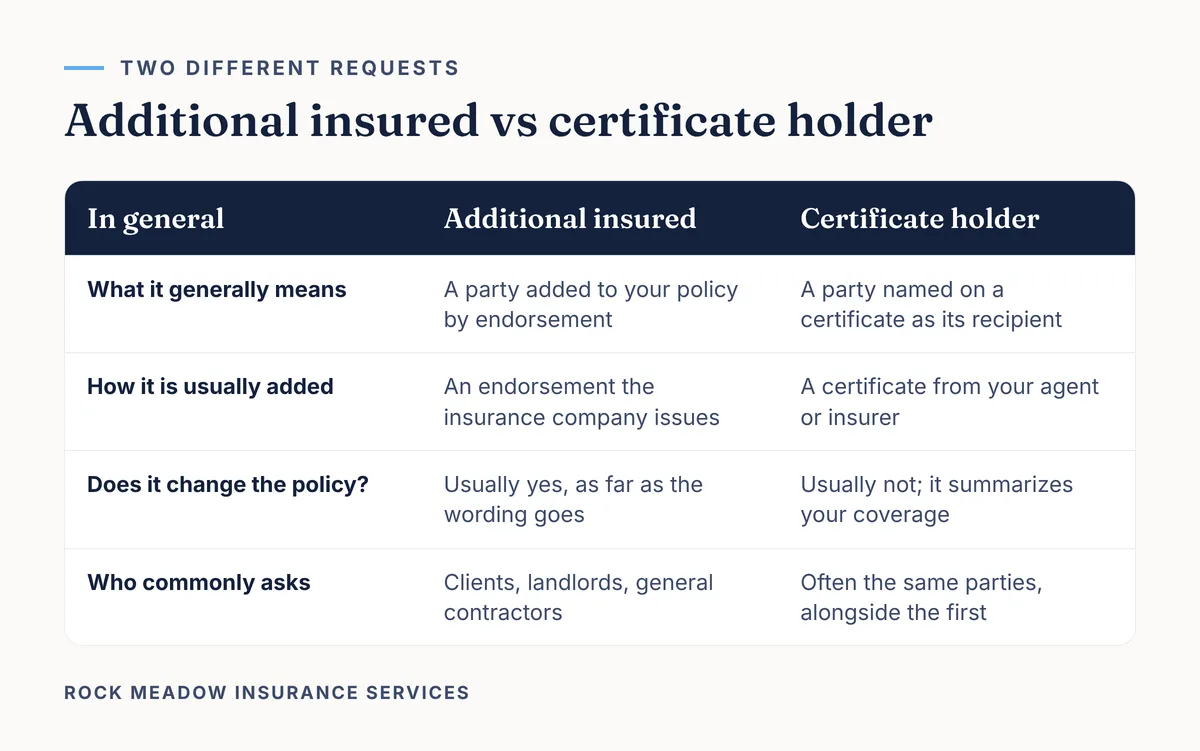
These requests point at your general liability insurance, the policy built for injury and property damage claims tied to your work. The exact words in the clause decide which request you’re dealing with:
| Additional insured | Certificate holder | |
|---|---|---|
| What it means | A party added to your policy for claims tied to your work or premises, as the endorsement says | The party a certificate of insurance is made out to |
| How it is added | An endorsement from the insurance company | A certificate from your agent or insurance company |
| Whether it changes the policy | Usually yes, as far as the endorsement wording goes | Usually not; it lists coverage you already have |
| Who asks | Clients, landlords and general contractors | The same parties, often alongside the first |
Being added to the policy is the bigger of the two asks, because it changes the policy itself.
What does additional insured mean?
Once the endorsement is in place, two parties have a link to your policy. The named insured is the party defined as the insured in the policy contract. For your business policy, that’s you.
The added party gets some protection under your policy without becoming the policyholder. That party might be a landlord, a client or a general contractor.
The endorsement wording sets how far that protection reaches. Many endorsements tie it to your work, your operations or the space you rent. They don’t extend your whole policy to the other party, and the policy documents decide what applies.
These endorsements can attach to a general liability policy. They can also attach to a business owners policy, which typically bundles general liability with property coverage. The NAIC small business insurance overview walks through what each policy type includes.
Three terms that often come with it
Clauses that ask for this status often ask for more wording at the same time. Each of these is a separate piece of policy wording, and a clause may name one, two or all three:
- Blanket additional insured: wording that covers anyone your written contracts require. You don’t name each party one by one. The conditions sit in the endorsement. For example, the contract may have to be signed before the work starts.
- Waiver of subrogation: subrogation is an insurer’s right to recover what it paid from a third party who caused the loss. A waiver gives up that right against the party the contract names.
- Primary and noncontributory: wording that says your policy responds before the other party’s own policy, and that their policy isn’t asked to share the loss.
All three are usually added by endorsement. The NAIC glossary of insurance terms defines endorsement, subrogation and other terms you may see in the clause. We tell clients to copy the exact terms their clause uses, so the agent can ask the insurer about each one by name.
What does a certificate holder get?
The other request is simpler. A certificate holder gets a record that your policy exists. The certificate of insurance is generally a short summary made out to that party. It usually shows the insurance company, the policy types, the policy dates and your limits as of the day it’s issued.
Being named on a certificate generally gives the holder no rights under your policy, because a certificate reports coverage rather than changing it. Additional insured status generally comes from an endorsement, not from the certificate.
That’s why contracts so often ask for both. The certificate is the paperwork the other party files, and the endorsement is the policy change behind it. If a clause says "certificate holder and additional insured," plan for a certificate request and an endorsement request.
Our guide to what a certificate of insurance is and how to get one walks through what’s on the form and how to request one.
Who asks for additional insured status, and why?
The party asking wants a direct link to your policy. That way, a claim from your work or your space doesn’t rest only on their own coverage. The contract they send sets the terms, and the endorsement wording sets how far the link reaches.
- General contractors write it into subcontracts. They ask subs to add them, and sometimes the project owner, by endorsement.
- Landlords and property managers ask for it in commercial leases, tied to the space you rent.
- Clients and venues ask for it in service agreements and event contracts, tied to the work or event you handle for them.
The clauses you see depend on your type of business. Trades can start with our page on insurance for contractors, and firms that manage buildings can see property management insurance.
The same clause often lists other policies and the limits it wants on each. Those are the asking party’s terms, so they change from one agreement to the next. Compare the limits the contract lists with the limits on your declarations page, the summary page of your policy. Note anything the clause asks for that you don’t carry yet.
How do you add an additional insured?
The request follows a set path. You ask your agent or insurance company for the endorsement, the insurer changes the policy, and the party asking gets a certificate that shows it.
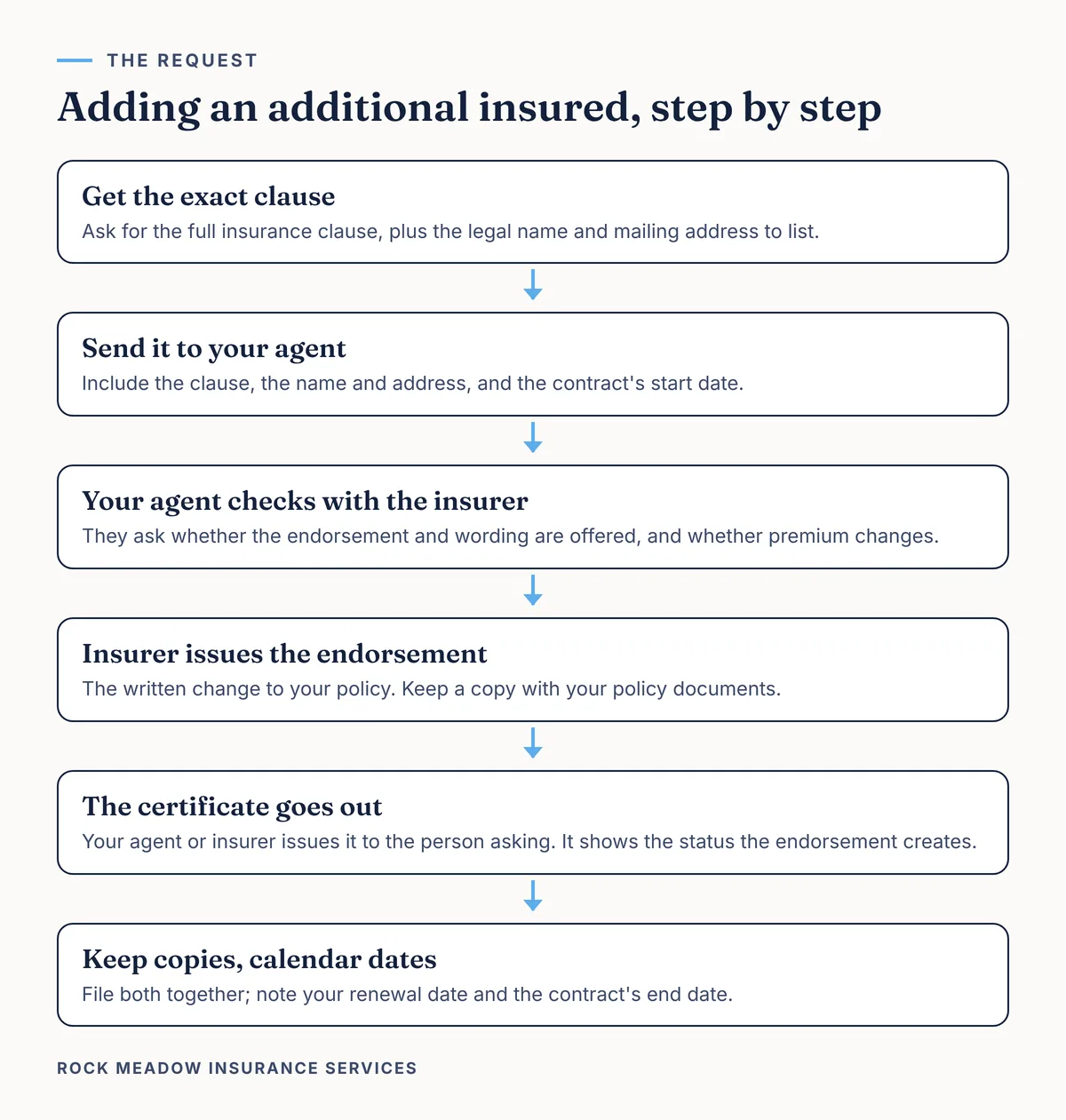
- Get the exact clause. Ask the other side for the full insurance clause, plus the legal name and mailing address they want listed. A trade name or project name in place of the legal name can mean a second round of paperwork.
- Send it to your agent. Include the clause, the name and address, and the contract’s start date.
- Your agent checks with the insurance company. They ask whether your policy offers the endorsement and wording the clause names, and whether adding it changes your premium. Any change depends on the insurer, your business and the endorsement requested.
- The insurer issues the endorsement. Keep a copy with your policy documents and check the final wording in writing.
- The certificate goes to the party asking. Your agent or insurance company issues it, showing the status the endorsement creates.
- Keep copies and calendar dates. File the endorsement and certificate with the contract. Put your renewal date and the contract’s end date on the calendar. Then you can confirm the endorsement is still there and send a new certificate when asked.
Start as soon as the contract arrives, since the insurer sets how long the endorsement takes.
What should you check before you sign?
Once the endorsement is requested, look at the contract again before you sign. Your attorney is the one who reads what it requires. We explain how these endorsements generally work, but we don’t interpret a specific contract or lease, or say whether a policy or endorsement satisfies one.
This short checklist works for your attorney and your agent. Go through it before you sign, and again before the work or lease starts:
- The full clause. Copy it from the contract, lease or agreement, including any exhibits it points to, with the legal name and address spelled the way the contract spells them.
- Which status? Additional insured, certificate holder or both.
- Named or blanket? Does the clause want the other party named on an endorsement, or blanket wording that reaches anyone your written contracts require?
- Which endorsements? Does it also mention waiver of subrogation or primary and noncontributory wording?
- Which limits? What limits does the contract list, and on which policies? Compare them line by line with your declarations pages.
- How long? Does the requirement end with the work or the lease, or does it continue after, and for how long?
If the clause lists coverage you don’t carry yet, a business owners policy quote is one place to start. The insurance company decides whether you qualify.
Common questions
Can I add an additional insured to my business owners policy?
Many business owners policies accept an additional insured endorsement, though it depends on the insurance company and the policy form. Send the clause to your agent. They can ask the insurer whether the endorsement is available, what it says and whether it changes the price of your policy, called the premium.
Does listing my landlord as a certificate holder make them an additional insured?
Generally, no. A certificate gives your landlord proof that your coverage exists, but it usually doesn’t change the policy. Adding your landlord to the policy takes an endorsement from the insurance company. If your lease asks for both, your agent can request the endorsement first, then send a certificate that shows it.
Do I need a new certificate every time a client asks to be added?
Usually, yes. A certificate is made out to one holder, so each client who wants proof gets their own. The endorsement is a separate question: blanket wording can reach every party your written contracts require, which may remove the need for a new endorsement each time.
Can my policy cover several additional insureds at once?
It can. One endorsement can list several parties by name, and blanket wording can reach more without naming each one. Policies differ in which of the two they offer. Before you sign several contracts in a short stretch, ask your agent which form your policy has, so each new request moves faster.
What happens to additional insured status when my policy renews?
It depends on the insurer and the endorsement. Some endorsements carry over to the renewal policy, and others have to be requested again. Your old certificate also shows the old policy dates, so the other party may ask for an updated one after renewal. Put both dates on your calendar.
Where we help
Shopping for coverage because a contract asks for it? Request a general liability quote and mention which endorsements the clause asks for, so the quotes reflect them.
If your business policy is with Rock Meadow, send us the insurance clause. Our team can request the endorsement from your insurance company and turn the certificate around quickly once it’s issued.
We work with clients across California and nationwide. Prefer to talk it through? Call our main line at (760) 654-6760.
Sources
- Small Business Insurance, National Association of Insurance Commissioners (NAIC): explains the coverage types small businesses consider, including how a business owners policy typically bundles general liability with property coverage.
- NAIC Glossary of Insurance Terms, National Association of Insurance Commissioners (NAIC): defines endorsement, named insured and subrogation.
Coverage, limits, exclusions and eligibility vary by policy and insurance company, and the policy documents decide what is covered. This article is general information, not legal or tax advice; confirm licensing, bond and workers' compensation requirements with the agency that applies to your business.