
Reviewed by Anthony Howe, Licensed Insurance Agent, NPN #20649362, CA License #4281027 on 2026-11-13
What this article covers: Business income coverage starts with covered damage to your property, and we show what it typically pays from there. Extra expense, civil authority and dependent property coverage handle cases it can’t reach alone. The clock has three parts: the waiting period, the period of restoration and the extended period. Flood, earthquake and virus are common exclusions. Buying it comes down to two routes, a business owner’s policy (BOP) or a commercial property policy. A short checklist names the records to gather before you set your limit.
What does business interruption insurance cover?
Maybe your renewal just landed. Maybe your landlord asked about it, or a neighbor’s shop had a fire and stayed closed for repairs.
Either way, you’ve spotted a gap. Property insurance repairs the building and what’s inside. It doesn’t replace the sales you lose while the doors are shut.
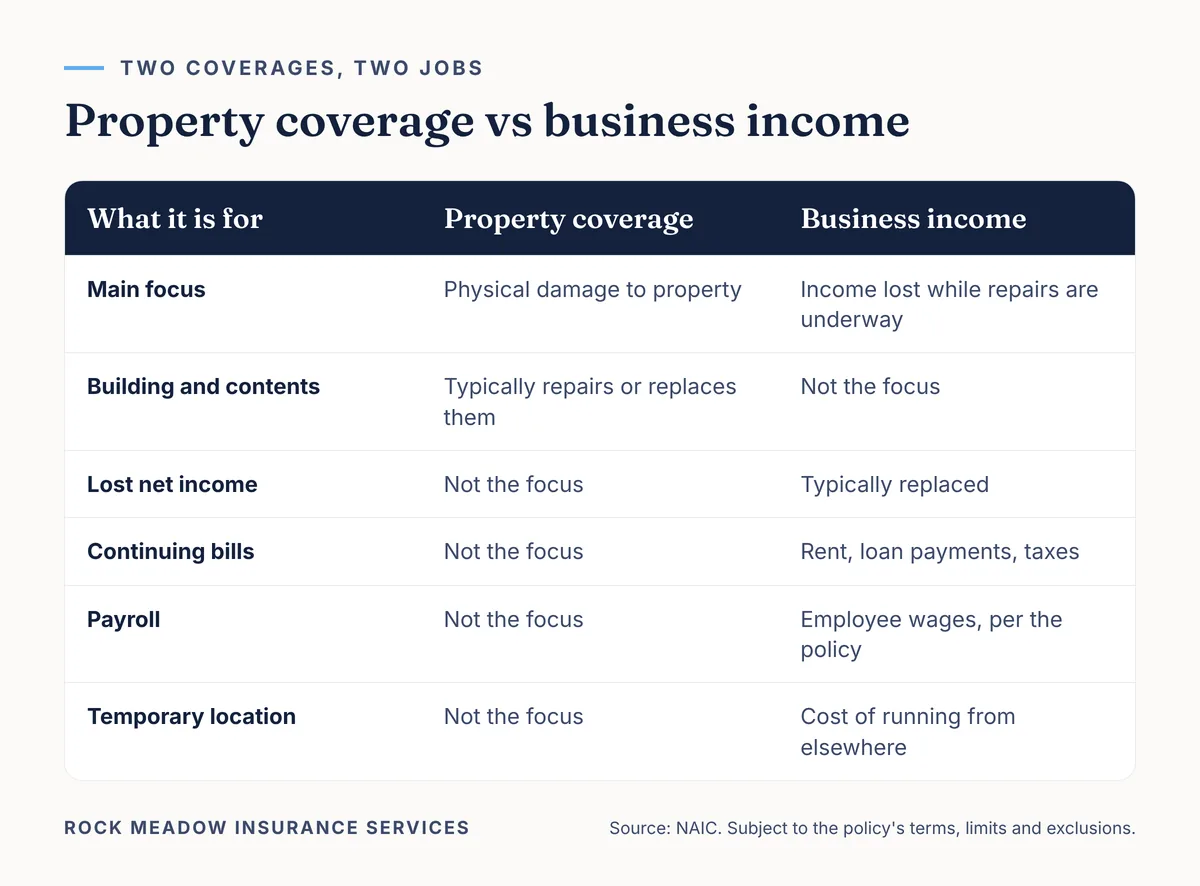
Business interruption insurance, also called business income insurance, is coverage for lost net income and continuing bills while a covered loss is repaired. What it pays is subject to the policy’s terms, limits and exclusions. Net income is what your business earns after its expenses.
It works alongside commercial property insurance. Property coverage is for the physical damage. Business income is for the income lost while repairs are underway.
What has to happen first
The trigger is a covered physical loss, like a fire, at your premises. Direct damage from a riot may count too, depending on the policy form. Without covered property damage, there’s usually no business income claim.
What it can pay
Once that trigger is met, business income may pay for these, up to the policy’s limits:
- Lost net income. The profit you would have earned if you’d stayed open.
- Continuing expenses. Bills that keep coming, such as rent or lease payments, loan payments and taxes.
- Payroll. Employee wages during the closure. Some forms limit ordinary payroll, which means pay for most staff other than officers and key managers.
- Temporary location costs. The cost of running the business from somewhere else while repairs go on.
Picture a restaurant closed after a kitchen fire. Property coverage is for the hood, the cooking line and the walls. Business income is for the lost dinner sales, the lease payment and the cooks’ wages during the rebuild. Our page on coverage for restaurants shows how these pieces fit for a food business.
The NAIC is the national group of state insurance regulators. Its overview, Business Interruption and Business Owner Policy (NAIC), explains the same basics. Business income is the core. A few related coverages reach the cases it can’t handle alone.
Where extra expense and civil authority fit
Business income looks at your own closed premises. Three related coverages stretch it to staying open, blocked access and damaged suppliers. Each one may be in the base policy or added by endorsement, which is a written change to a policy.
Extra expense
Extra expense coverage repays added costs you take on during repairs. Rent at a temporary location is a common example. It fits when staying open, or reopening sooner, costs more than closing.
Civil authority
Civil authority coverage is for a government order that blocks access to your business after covered damage nearby. It may apply even if your own space isn’t damaged. It carries its own time limits and waiting periods, set by the policy form.
One standard industry form sets three conditions. Access to your premises has to be completely blocked. There has to be physical damage near your property. And a covered peril, meaning a cause of loss like fire or wind, has to cause that damage.
Dependent property (contingent business interruption)
Contingent business interruption, or CBI, is for income lost when a key supplier or customer is damaged. The damage has to be a type your own policy covers. CBI is an optional add-on, called a rider.
It doesn’t cover every peril, and the insurer may ask you to list specific supplier and customer locations. Change suppliers without updating the policy, and the new one is left out.
Say a gift shop buys most of its stock from one maker, and that maker’s warehouse burns. CBI is the piece that may respond, if the policy lists that supplier. Our page on coverage for retail stores shows the other policies a shop may carry. Triple-I explains the limits in Contingent business interruption and supply chain disruption (Triple-I).
Here’s how the four compare:
| Coverage | What sets it off | What it may pay | How it’s added |
|---|---|---|---|
| Business income | Covered physical damage at your premises | Lost net income and continuing expenses | Base policy or endorsement |
| Extra expense | Covered damage at your premises | Added costs to stay open or reopen, such as temporary rent | Included or added |
| Civil authority | A government order blocks access after covered damage nearby | Lost income during the order, within its time limits | A clause in many policies |
| Contingent business interruption | A covered type of damage at a key supplier or customer | Lost income from that disruption | Optional rider |
The NAIC lists these add-ons in What Business Income Loss Coverages Are Out There? (NAIC). Every one of them runs on a clock, and that clock decides when payments start and stop.
How long does business interruption insurance pay?
Business interruption insurance pays within two kinds of limits: time and money. The time side has three parts, and each one is set by your policy form.
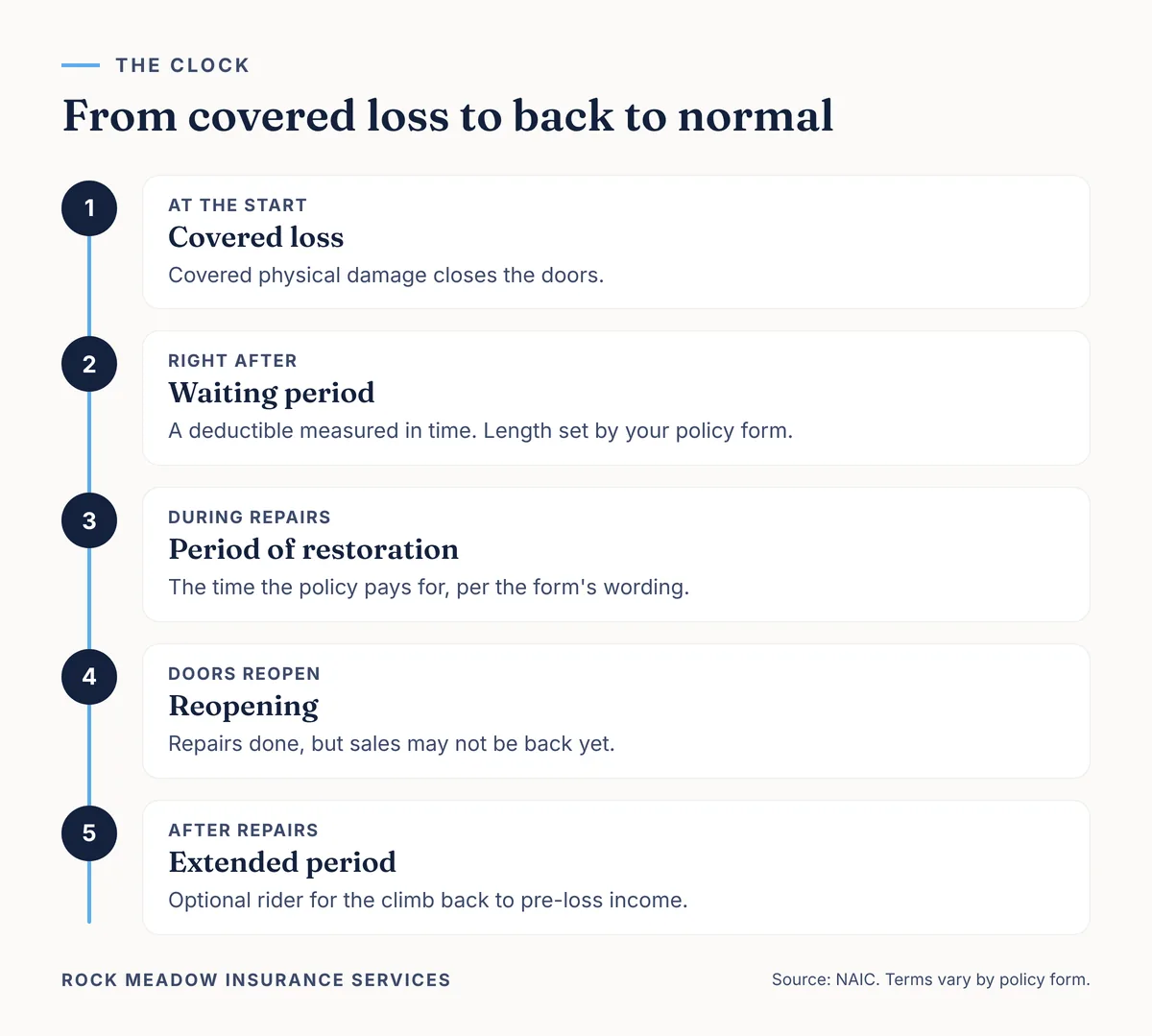
The waiting period
The waiting period is a deductible measured in time. It’s the stretch right after the loss, before business income starts to pay. Its length comes from the policy form and is shown in your policy. No single number applies to every business.
The period of restoration
The period of restoration is the time the policy pays for. On many forms it starts when the waiting period ends and ends when the property could be repaired with reasonable speed. That end point is tied to the repairs, not to the day your sales fully return.
The extended period
Reopening isn’t the same as being back to normal, since customers can take a while to come back. Extended business interruption is for that gap, after repairs are done but before income returns to pre-loss levels. It’s an optional rider.
The dollar limit
The policy also pays only up to a set dollar limit, shown on your declarations page, the summary page at the front of your policy. Triple-I says to look for coverage that lasts longer than a few days. Getting a business back on track often takes much longer than people expect. So check the time terms and the dollar limit together.
Triple-I’s Insuring Your Business Against a Catastrophe (Triple-I) covers planning for a long recovery. Even inside that window, though, some causes of loss don’t count at all.
What business interruption usually leaves out
An exclusion is a cause of loss a policy won’t cover. Exclusions differ from one policy to the next, and your policy documents decide. So treat this as a list of what many policies exclude or limit.
- Flood, earthquake and mudslide. Business interruption doesn’t typically cover these unless you buy added coverage for them. Many property policies exclude flood damage, and flood coverage is a separate policy in many cases.
- Virus and pandemic. Many policies exclude losses unrelated to property damage, such as sales lost to an outbreak. A standard virus exclusion came out in 2006, and many insurers have added that kind of wording since.
- Utility outages that start elsewhere. A power or service loss away from your premises may need a service interruption clause. That clause can cover damage to utility lines and equipment. It can carry distance limits, and perils such as earthquake are commonly left out.
- No physical damage. A slow season or a lost client, with no covered damage, isn’t a business income loss.
- Income you can’t document. A claim leans on your records, so sales with no paper trail are hard to count.
Business income also isn’t liability coverage. If a customer slips and gets hurt in your shop, that claim is typically a matter for general liability coverage, not business income.
If you have a loss right now, your agent and your policy are where to start. How you buy the coverage also shapes which add-ons are on offer.
How to add business income coverage
Business income can be part of a business owner’s policy, a commercial property policy or a package policy. It may come in the base form or by endorsement. For a small business, two routes are common, and each has trade-offs.
Inside a business owner’s policy
A business owner’s policy (BOP) packages property, business interruption and liability coverage in one policy. Its business interruption part can include the extra expense of a temporary location. Business interruption is often bundled this way.
Many small businesses may qualify for a BOP. Underwriting, the insurer’s review of your business, decides. One policy is simpler to manage. The package sets the options, though, so some add-ons may not be offered.
Added to a commercial property policy
Business income can also go on a commercial property policy. This route may fit a business that doesn’t qualify for a BOP or wants different terms. It can mean more pieces to set up and keep track of.
What sits outside both
A BOP doesn’t include professional liability, auto, workers’ comp, or health and disability coverage. Those are separate policies, such as workers’ comp for your employees. An LLC is a business structure, not insurance, so it doesn’t replace lost income either. Our article on what an LLC protects and what it doesn’t has more, and an attorney can speak to your own setup.
Cost depends on your industry, your number of employees, how much coverage you choose and where you’re located. Triple-I lists what a package holds in What does a business owners policy cover? (Triple-I). Whichever route you pick, the limit rests on your own numbers.
Before you set your limit
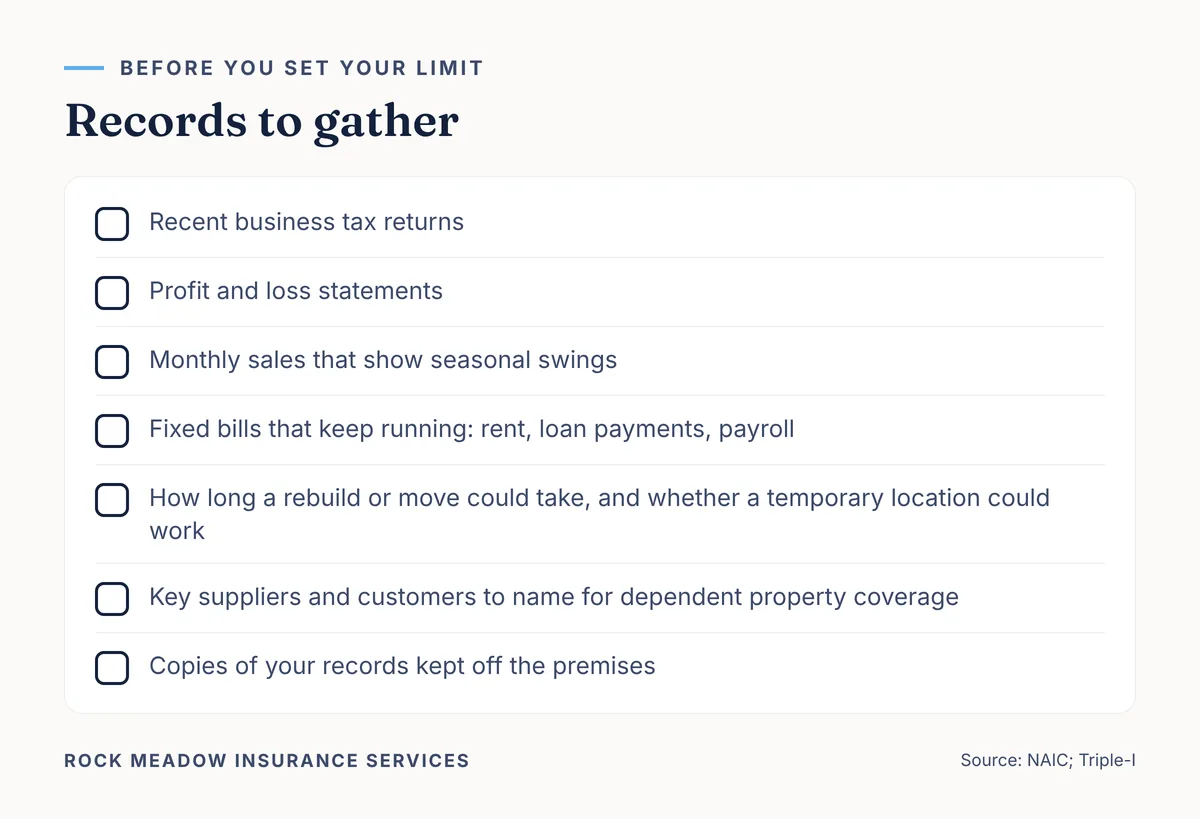
You choose the dollar limit with your agent. A claim later leans on the same numbers, because business income is based on your own financial records. So gather them before you compare options.
- Your recent business tax returns.
- Profit and loss statements.
- Monthly sales that show how your income changes by season.
- A list of fixed bills that keep running, such as rent, loan payments and payroll.
- Whether a temporary location could work, and a rough sense of how long a rebuild could take.
- The key suppliers and customers you’d name for dependent property coverage.
- Copies of your records kept off the premises.
With those in hand, the worksheet is short. Add the net income you’d expect to earn to the bills that keep running. Then stretch that over a realistic repair time, with room for slow seasons. Your agent can help you work through it and read the policy for exclusions.
When you pick a policy, confirm the waiting period, the period of restoration and any extended period in writing. Those terms vary by policy, and the policy documents decide.
Renting your space? Tenants can insure their own income and contents, even when the landlord insures the building. Leases often ask tenants for proof of coverage, and our article on how a certificate of insurance works explains that proof.
If your policy is with Rock Meadow, our team can help you review your business income limit. If you’re comparing options, you can request a commercial property quote or request a business owner’s policy quote.
Common questions
Is business interruption included in my property insurance?
Not always. Business income may already be in a BOP or package policy, or it may need an endorsement on a commercial property policy. A plain property policy can cover the building and contents with no income coverage at all. Check your declarations page for a business income line and its limit. Your agent can confirm what’s there.
Will business interruption insurance cover my payroll?
It can. Many business income forms count employee wages as a continuing expense during a covered closure. The payroll wording usually sits in the business income form itself, sometimes with a separate line for ordinary payroll. Ask your agent to point you to that wording and explain how it applies.
Does business interruption insurance cover a pandemic?
On many policies, no. Business income starts with physical damage from a covered cause, and an outbreak alone usually leaves nothing damaged. Virus exclusion wording is also common. To see where your policy stands, ask your agent which page holds the virus wording and whether any endorsement changes it.
Does a power outage count as a business interruption loss?
Sometimes. An outage caused by covered damage at your own premises may count. When the trouble starts at a utility or along its lines, coverage usually depends on a service interruption clause. That clause can cap how far away the damage happens and may leave out perils such as earthquake. Your agent can tell you whether your policy has one.
Do I need business income coverage if I rent my space?
It may be worth considering. Renting doesn’t change what happens to your sales if a covered loss closes your space. A landlord’s insurance is written for the landlord, not for your lost income. A tenant can carry its own business income coverage. Some leases also ask tenants for certain coverages, so include that clause with any quote request.
What is the waiting period on my business interruption policy?
It’s whatever your policy form says. The waiting period is the stretch after a covered loss before business income starts to pay, and its length varies by form and insurer. Look for it on your declarations page or in the business income form. Civil authority coverage can carry its own waiting period, too.
Where we help
Clients across California and nationwide work with Rock Meadow Insurance Services. We help business owners compare business income coverage on a commercial property policy or a BOP. To get started, use the commercial property quote form. If a lease or contract lists coverages, include that clause with your request so we know what to ask insurers about.
Prefer the phone? Call (760) 654-6760. If you’d like to go over your options first, you can talk with our team. There’s no pressure to buy.
Sources
- Business Interruption and Business Owner Policy, National Association of Insurance Commissioners (NAIC). What business interruption covers and its physical-damage trigger, civil authority conditions, contingent and extended business interruption riders, flood, earthquake, mudslide and virus exclusions, BOP bundling and cost drivers.
- What Business Income Loss Coverages Are Out There?, National Association of Insurance Commissioners (NAIC). Where business income is written (BOP, property policy or endorsement), typically covered expenses, extra expense, civil authority limits, service interruption, contingent business interruption, and the records and planning behind a limit.
- Insuring Your Business Against a Catastrophe, Insurance Information Institute (Triple-I). Coverage based on the business’s own financial records, limits that last more than a few days, flood exclusions on typical property policies, and keeping copies of records off the premises.
- Protecting Your Business Against Contingent Business Interruption and Supply Chain Disruption, Insurance Information Institute (Triple-I). Contingent business interruption needs physical damage at a supplier or customer, doesn’t cover every peril, and may require listed locations.
- What Does a Business Owners Policy (BOP) Cover?, Insurance Information Institute (Triple-I). What a BOP packages (property, business interruption with extra expense, liability) and what it leaves out (professional liability, auto, workers’ comp, health and disability).
Coverage, limits, exclusions and eligibility vary by policy and insurance company, and the policy documents decide what is covered. This article is general information, not legal or tax advice; confirm licensing, bond and workers' compensation requirements with the agency that applies to your business.